

This guide provides a comprehensive overview of Sweden address formatting, postal code structures, and localization practices. It includes information on postal services, languages, time zones, and address validation standards across Sweden.
Address Format
Structure for standardized Sweden postal addresses.
- Organization
- Thoroughfare PremisesNumber SubBuilding SubPremisesLevel SubPremises
- PostBoxType PostBoxNumber
- PostalCode Locality
- Country
Address Verification Data
Sweden postal addresses verification data.
| Available: | Yes |
| Does the country use Postal Codes: | Yes |
| PO Box Indicator: | Postlåda, PO Box |
| ISO-2-Code: | SE |
| ISO-3-Code: | SWE |
| Phonecode: | 46 |
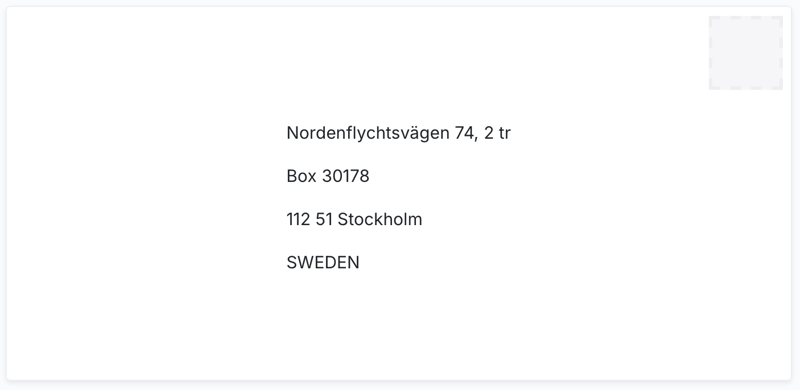
Address Example
Example of standardized Swedish postal addresses.
Country Info
Full Country Name: Kingdom of Sweden
| Country Alpha-2 code | SE |
|---|---|
| Country Alpha-3 code | SWE |
| Numeric Code | 752 |
Timezone
Belgium Time Zone Details
| Time Zone | UTC | DST |
|---|---|---|
|
Central European Time |
UTC+1 | UTC+2 |
Official Language
Swedish is the official language. Finnish, Meänkieli, Sami, Romani, and Yiddish are recognized minority languages.
Fun Fact
- The total area of Sweden is about 450,295 sq km / 173,860 sq miles, making it one of the largest countries in Europe. (CIA World Factbook)
- Sweden has a coastline of approximately 3,218 km / 1,999 miles, bordering the Baltic Sea and the Gulf of Bothnia. (CIA World Factbook)
- Sweden has been a constitutional monarchy since 1809, with a long history of political stability and neutrality. (CIA World Factbook)
- Natural hazards include flooding, storms, and winter-related risks, particularly in northern regions. (CIA World Factbook)
- Life expectancy averages around 83 years, among the highest in Europe. (CIA World Factbook)
- The population is aging but supported by immigration, helping offset low birth rates. (CIA World Factbook)
- The terrain ranges from mountainous regions in the northwest (Scandinavian Mountains) to forests, lakes, and flat coastal lowlands in the south and east. (CIA World Factbook)
Name Conventions
Population Names
In Sweden, names follow the Western naming convention with given name(s) preceding the family name:
[opt: title] [given name] [opt: middle name(s)] [FAMILY NAME] [opt rare: suffix]
Examples:
- Anders Eriksson d.ä.
- Anna Andersson
- Dr. Lars Johansson
- Maria Eva Larsson
Swedish names use the Latin alphabet with the additional letters å, ä, and ö.
Common titles include Herr (Mr.), Fru (Mrs.), and Fröken (Miss, archaic). Professional titles like Dr. (doktor) and Prof. (professor) are also used.
Swedish surnames historically were patronymic (ending in -son or -dotter), but are now hereditary family names.
Upon marriage, either spouse may keep their surname, adopt their partner's surname, or both may use a hyphenated combination. Since 2017, couples can also create a new combined surname.
Swedish naming law requires given names to be approved if they are uncommon. Names must not cause offense or discomfort to the child.
Middle names are common, and individuals may have multiple middle names.
Organizational Names:
Swedish businesses must register with the Swedish Companies Registration Office (Bolagsverket). Common legal entity designations include:
AB (Aktiebolag) – Private limited company
Publ. AB (Publikt Aktiebolag) – Public limited company
HB (Handelsbolag) – General partnership
KB (Kommanditbolag) – Limited partnership
Ek. för. (Ekonomisk förening) – Economic association
Company names must be distinguishable from existing companies and cannot be misleading. The legal designation typically appears at the end of the company name.