






This guide provides a comprehensive overview of Switzerland address formatting, postal code structures, and localization practices. It includes information on postal services, languages, time zones, and address validation standards across Switzerland.
Address Format
Structure for standardized Switzerland postal addresses:
- Organization / Building
- Building
- Thoroughfare PremisesNumber / SubPremises OR SubPremisesLevel
- PostBoxType PostBoxNumber
- PostalCode Locality
- Country
Address Verification Data
Switzerland postal addresses verification data
| Available | Yes |
| Does the country use postal codes? | Yes |
| PO Box Indicator | Postfach, Case Postale, Casella Postale, Poste Restante |
| ISO-2-Code | CH |
| ISO-3-Code | CHE |
| Phonecode | 41 |
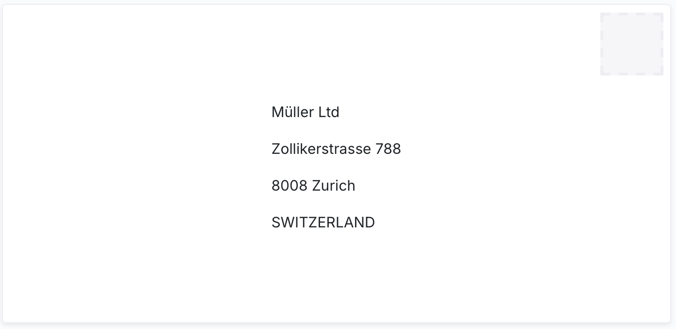
Address Example
Example of standardized Switzerland postal addresses
Country Info
Full Country Name: Swiss Confederation (Schweizerische Eidgenossenschaft / Confédération suisse / Confederazione Svizzera / Confederaziun svizra)
| Country Alpha-2 code | CH |
|---|---|
| Country Alpha-3 code | CHE |
| Numeric Code | 756 |
Time Zone
Switzerland Time Zone Details
| Time Zone | UTC | DST |
|---|---|---|
| Central European Time (CET) | UTC+1 | UTC+2 |
Official Language
Switzerland has four official languages: German, French, Italian, and Romansh.
Fun Facts
- The total area of Switzerland is about 41,277 sq km / 15,940 sq miles. (CIA World Factbook)
- Switzerland is landlocked, with no coastline, and relies on rivers and rail networks for trade. (CIA World Factbook)
- Life expectancy is among the highest globally, averaging about 84 years. (CIA World Factbook)
- The terrain is mostly mountainous, dominated by the Alps and Jura Mountains, with the Swiss Plateau housing most of the population. (CIA World Factbook)
- Switzerland borders France, Germany, Austria, Liechtenstein, and Italy, placing it at the center of Europe. (CIA World Factbook)
Postal Authority
The Swiss Post (Die Schweizerische Post / La Poste Suisse / La Posta Svizzera) is the national postal service of Switzerland, operating as a public company owned by the Swiss Confederation. It provides domestic and international mail and parcel delivery, financial services through PostFinance, and digital solutions. Swiss Post ensures universal postal services across all cantons, maintaining a network of post offices and self-service points throughout the country.
Reference: https://www.post.ch
Postal Data & Certification
Swiss Post maintains a database of all street addresses in Switzerland as well as Liechtenstein. This information includes alternative street and city names, foreign language versions, as well as postal carrier information.
Melissa uses the official Swiss postal address data for both Switzerland and Liechtenstein in our Global Address solution.
Name Conventions
Population Names
[opt: title] [given name] [opt: middle name(s)] [FAMILY NAME]
Examples:
- Herr Dr. Lukas Meier
- Madame Claire Dubois
- Prof. Markus von Keller
In Switzerland, names follow the Western naming convention and are regulated by the Swiss Civil Code. The typical structure includes one or more given names followed by a family name. Naming laws are applied by the local civil registry offices (Zivilstandsamt/Office d’état civil/Ufficio dello stato civile), ensuring that names are not offensive, overly fanciful, or detrimental to the child’s well-being.
Multilingual naming customs reflect the country’s four official languages (German, French, Italian, and Romansh). Diacritical marks such as ä, ö, ü, é, è, à, and ç are legally supported and commonly used. Traditionally, children inherit the father’s surname, but since legal reforms in 2013, parents may choose either parent’s surname or a double-barreled combination.
Titles such as Herr/Monsieur/Signor (Mr.), Frau/Madame/Signora (Mrs.), and academic titles like Dr. or Prof. are widely used in formal contexts but are not part of the legal name.
Organizational Names
Swiss companies must be registered in the Handelsregister (German), Registre du commerce (French), or Registro di commercio (Italian), and the official name must include the correct legal entity designation.
Common examples include:
- AG / SA (Aktiengesellschaft / Société Anonyme) - Public limited company or stock corporation
- GmbH / Sàrl / Sagl (Gesellschaft mit beschränkter Haftung / Société à responsabilité limitée / Società a garanzia limitata) - Private limited company
- KolG / SNC (Kollektivgesellschaft / Société en nom collectif) - General partnership
Business names must be unique, linguistically appropriate for the region of registration, and must clearly indicate the legal form.