







This guide provides a comprehensive overview of Portuguese address formatting, postal code structures, and localization practices. It includes information on postal services, languages, time zones, and address validation standards across Portugal.
Address Format
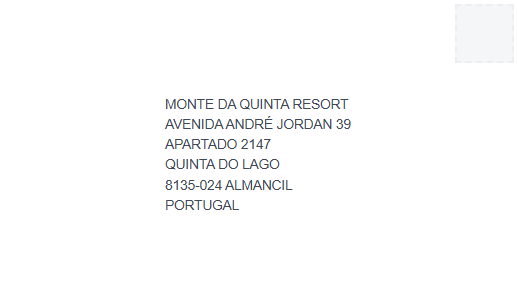
Structure for standardized Portuguese postal addresses:
- Organization
- SubPremisesLevel SubPremises
- SubBuilding Building
- PremisesNumber Thoroughfare
- PostBoxType PostBoxNumber
- PostalCode Locality
- Country
Address Verification Data
Portugal postal addresses verification data
| Available | Yes |
| Does the country use postal codes? | Yes |
| PO Box Indicator | Apartado |
| ISO-2-Code | PT |
| ISO-3-Code | PRT |
| Phone Code | 351 |
Address Example
Country Info
Full Country Name: Portuguese Republic (República Portuguesa)
| Country Alpha-2 code | PT |
|---|---|
| Country Alpha-3 code | PRT |
| Numeric Code | 620 |
Time Zone
Portugal Time Zone Details
| Time Zone | UTC | DST |
|---|---|---|
| Western European Time (WET) | UTC+0 | UTC+1 |
Official Language
The official language is Portuguese.
Fun Facts
- Portugal covers an area similar in size to the U.S. state of Indiana.
- The country has diverse geography, including a long Atlantic coastline, river valleys, and mountain ranges such as the Serra da Estrela.
- Portugal is one of Europe’s most popular tourist destinations.
- It shares borders with only one country, Spain, and is otherwise surrounded by the Atlantic Ocean.
- The Tagus River (Rio Tejo) is the longest river in the Iberian Peninsula, flowing through Portugal into the Atlantic Ocean.
Postal Authority
CTT (Correios de Portugal) is the national postal service of Portugal. It provides comprehensive mail and parcel delivery services, express courier, and financial services throughout mainland Portugal, the Azores, and Madeira.
Reference: https://www.ctt.pt
Postal Data & Certification
Portugal’s national postal authority is CTT - Correios de Portugal, S.A.
CTT is responsible for:
- Defining official postal addressing standards
- Assigning and maintaining postal codes
- Providing nationwide mail and parcel delivery services
Portugal uses a national postal code system consisting of 7 digits, commonly written as NNNN-NNN. Postal codes are required for accurate mail delivery and address standardization.
CTT does not publish a public vendor certification program for address validation software comparable to programs such as CASS (United States), SERP (Canada), or AMAS (Australia).
Address validation quality in Portugal is determined by:
- Compliance with CTT address formatting rules
- Correct postal code usage
- Alignment with postal reference data maintained by CTT
PO Box addresses are supported nationwide and are referred to as Apartado.
Postal Code Format
Portuguese postal codes follow a numeric “NNNN-NNN” format, where the first four digits identify the municipality or locality and the final three digits specify the delivery zone, street segment, or large volume recipient. For accurate processing and optimal routing through CTT (Portugal’s postal service), codes must always include the hyphen and seven digits.
Example: 1000-001 Lisboa
Name Conventions
Population Names
In Portugal, names follow a unique convention with given name(s) followed by multiple family names from both parents:
[opt: title] [given name] [opt: middle name] [maternal surname(s)] [paternal surname(s)] [opt: suffix]
Examples:
- Isabel Leonor Figueira MD
- Doutor Daniela Q. Ruah
- Marcelo Nuno Duarte Rebelo de Sousa
- Sr. & Senhora Joao & Isabel Santos
Portuguese names use the Latin alphabet with accented characters (á, à, â, ã, é, ê, í, ó, ô, õ, ú, ç).
Common titles include Sr. (Senhor, Mr.), Sra. (Senhora, Mrs.), D. (Dom/Dona, respectful), and professional titles like Dr., Eng. (Engineer), Arq. (Architect).
Portuguese traditionally use both maternal and paternal surnames. Children receive surnames from both parents, typically the mother's surname(s) followed by the father's surname(s).
The final surname (usually paternal) is considered the primary surname and is used for alphabetization.
Compound names with religious references are common (e.g., João Pedro, Maria Luísa, José António).
Upon marriage, individuals may keep their names, adopt their spouse's surnames, or combine them in various ways.
Some Portuguese names include "de," "da," "do," "dos," "das" (meaning "of/from"), which are considered part of the surname but written in lowercase.
Organizational Names
Portuguese businesses must register with the Conservatória do Registo Comercial. Common legal entity designations include:
- S.A. (Sociedade Anónima) – Public limited company
- Lda. (Sociedade por Quotas) – Private limited company
- Unipessoal Lda. – Single-member private limited company
- S.N.C. (Sociedade em Nome Colectivo) – General partnership
- S.C.A. (Sociedade em Comandita por Acções) – Partnership limited by shares
Company names must be unique and cannot be misleading or identical to existing companies. The legal designation typically appears at the end of the company name, separated by a comma.