






This guide provides a comprehensive overview of Argentina address formatting, postal code structures, and localization practices. It includes information on postal services, languages, time zones, and address validation standards across Argentina.
- Organization
- Building
- Thoroughfare PremisesNumber
- SubPremisesLevel SubPremises
- PostalCode
- Locality
- Country
Address Verification Data
Argentina postal addresses verification data
| Available | Yes |
| Does the country use postal codes? | Yes |
| PO Box Indicator | AR |
| ISO-2-Code | AR |
| ISO-3-Code | ARG |
| Phonecode | +54 |
Address Example
Example of standardized Argentina postal addresses
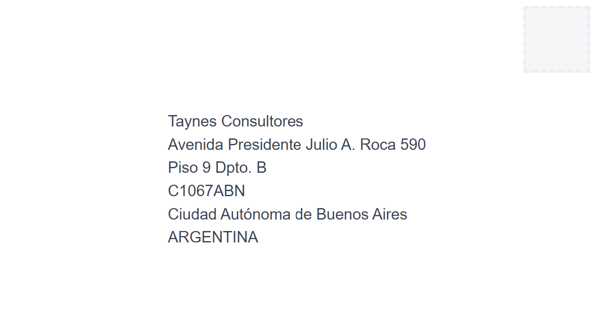
Country Info
Full Country Name: Argentine Republic
| Country Alpha-2 code | AR |
|---|---|
| Country Alpha-3 code | ARG |
| Numeric Code | 032 |
Time Zone
Argentina Time Zone Details
| Time Zone | UTC | DST |
|---|---|---|
| Argentina Time | UTC−3 | N/A |
Daylight saving time is not currently observed in Argentina.
Official Language
Spanish is the official de facto language. Indigenous languages such as Quechua, Guaraní, and Mapudungun are recognized regionally.
Fun Facts
- Argentina is the second-largest country in South America, covering an area slightly larger than the U.S. state of Texas. (CIA)
- The country features diverse geography, including Atlantic Ocean coastlines, the Andes mountain range, vast Pampas plains, and Patagonia’s rugged landscapes. (CIA)
- Argentina is one of the most visited countries in South America by international tourists. (The World Pursuit)
- It is often associated with tango, a world-famous dance and musical style that originated in Buenos Aires.
- Argentina shares land borders with five countries: Chile, Bolivia, Paraguay, Brazil, and Uruguay. (CIA)
- The Paraná–La Plata river system is among the most important waterways in Argentina, supporting trade, transportation, and agriculture.
Postal Authority
Correo Argentino is the national postal service of Argentina. It provides comprehensive mail and parcel delivery services, financial services, and logistics throughout all provinces and territories of Argentina, including remote regions of Patagonia.
Reference: https://www.correoargentino.com.ar
Postal Data & Certification
Argentina’s national postal authority is Correo Argentino (Correo Oficial de la República Argentina S.A.).
Argentina uses the Código Postal Argentino (CPA) postal code system for address standardization and mail delivery. CPA postal codes are commonly represented as 8 characters (a leading letter, four digits, and three letters).
Argentina does not publish a widely recognized public vendor certification program for address validation software comparable to programs such as CASS (United States), SERP (Canada), or AMAS (Australia).
Address validation quality in Argentina is primarily driven by:
- Correct use of the CPA postal code
- Compliance with Argentina’s addressing conventions (street name/number, locality, province, CPA)
- Alignment with postal reference data and standards maintained by the national postal system
Postal Code Format
In Argentina, postal codes consist of 8 characters formatted as a letter followed by 4 digits, then 3 letters (XNNNNXXX). The Código Postal Argentino (CPA) system was introduced in 1999. The code appears after the street address and before or after the locality name.
Example: Av. Corrientes 1234, C1043AAZ, Ciudad Autónoma de Buenos Aires
Name Conventions
Population Names
In Argentina, names follow the Spanish naming convention with one or more given names followed by paternal and sometimes maternal surnames:
[opt: title] [given name][opt: second given name] [opt: middle name(s)] [paternal FAMILY NAME][opt, uncommon: maternal FAMILY NAME] [opt, rarely used: suffix]
Examples:
- Sr. Juan Carlos Pérez
- Sra. María García
- Dr. Diego Martín López
- Ana Paula Rodríguez
Argentine names use the Spanish alphabet including accented characters (á, é, í, ó, ú, ñ).
Common titles include Sr. (Señor, Mr.), Sra. (Señora, Mrs.), Srta. (Señorita, Miss), and professional titles like Dr. (Doctor), Ing. (Engineer), Arq. (Architect).
Traditionally, individuals use both their father's and mother's surnames, though in practice the paternal surname is most commonly used.
Women traditionally retain their maiden names after marriage, though they may append "de" followed by their husband's surname (e.g., María García de López).
Compound given names are common, such as Juan Carlos, María José, or Ana María.
The use of "y" (and) between surnames (e.g., García y López) is formal and less common in modern practice.
Organizational Names
Argentine businesses must register with the Inspección General de Justicia (IGJ) or provincial authorities. Common legal entity designations include:
- S.A. (Sociedad Anónima) – Stock corporation
- S.R.L. (Sociedad de Responsabilidad Limitada) – Limited liability company
- S.C.S. (Sociedad en Comandita Simple) – Simple limited partnership
- S.C.A. (Sociedad en Comandita por Acciones) – Limited partnership by shares
- S.A.S. (Sociedad por Acciones Simplificada) – Simplified stock company
Company names must be unique within the jurisdiction and cannot be misleading or contain prohibited terms. The legal designation typically appears at the end of the company name.