






This guide provides a comprehensive overview of Peru address formatting, postal code structures, and localization practices. It includes information on postal services, languages, time zones, and address validation standards across Peru.
Address Format
Structure for standardized Peru postal addresses:
- Organization
- Thoroughfare PremisesNumber
- Building SubPremises SubPremisesLevel
- PostBoxType PostBoxNumber
- DependentLocality
- PostalCode
- Locality
- Country
Address Verification Data
Peru postal addresses verification data
| Available | Yes |
| Does the country use postal codes? | Yes |
| PO Box Indicator | Apartado Postal, Casilla Postal, PO Box |
| ISO-2-Code | PE |
| ISO-3-Code | PER |
| Phonecode | 51 |
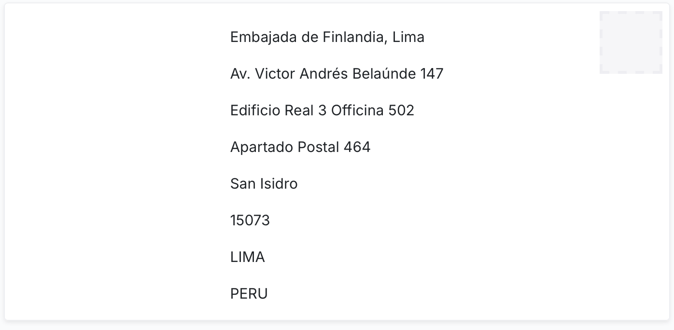
Address Example
Example of standardized Peru postal addresses
Country Info
Full Country Name: Republic of Peru
| Country Alpha-2 code | PE |
|---|---|
| Country Alpha-3 code | PER |
| Numeric Code | 604 |
Time Zone
Peru Time Zone Details
| Time Zone | UTC | DST |
|---|---|---|
| Peru Time | UTC-5 | N/A |
Daylight saving time is not observed
Official Language
Spanish, Quechua, and Aymara are official languages. Additionally, numerous indigenous languages are recognized regionally.
Fun Facts
- The total area of Peru is about 1,285,216 sq km / 496,225 sq miles, making it one of the largest countries in South America. (CIA World Factbook)
- Peru has a coastline of approximately 2,414 km / 1,500 miles along the Pacific Ocean. (CIA World Factbook)
- The terrain is extremely diverse, including coastal plains, the Andes Mountains, and the vast Amazon rainforest in the east. (CIA World Factbook)
Postal Authority
Serpost (Servicios Postales del Perú) is the national postal service of Peru. It provides mail and parcel delivery services, courier services, and financial services throughout all regions of Peru, including the Amazon and Andean regions.
Reference: https://www.serpost.com.pe
Name Conventions
Population Names
In Peru, names follow the Spanish naming convention with one or more given names followed by paternal and maternal surnames:
[opt: title] [given name] [opt: second given name] [paternal surname] [maternal surname]
Examples:
- Arq. Roberto Espinosa Vera
- Sra. Beatriz Morales de Mendoza
- Dr. Francisco Paredes Choque
- María José Villanueva Ruiz
Peruvian names use the Spanish alphabet including accented characters (á, é, í, ó, ú, ñ).
Common titles include Sr. (Señor), Sra. (Señora), Srta. (Señorita), and professional titles like Dr., Ing. (Ingeniero), Abog. (Abogado).
Both paternal and maternal surnames are used in formal documentation, with the paternal surname appearing first.
Women retain their maiden names after marriage and do not traditionally adopt their husband's surname.
Indigenous Peruvians may have Quechua or Aymara names alongside or instead of Spanish names.
The RENIEC (Registro Nacional de Identificación y Estado Civil) manages name registration.
Organizational Names
Peruvian businesses must register with SUNARP (Superintendencia Nacional de los Registros Públicos). Common legal entity designations include:
- S.A.C. (Sociedad Anónima Cerrada) – Closed stock corporation
- S.A. (Sociedad Anónima) – Stock corporation
- S.R.L. (Sociedad de Responsabilidad Limitada) – Limited liability company
- E.I.R.L. (Empresa Individual de Responsabilidad Limitada) – Individual limited liability company
- S. en C. (Sociedad en Comandita) – Limited partnership
Company names must be distinctive and cannot conflict with existing registrations. The legal designation typically appears at the end of the company name.