






This guide provides a comprehensive overview of Türkiye address formatting, postal code structures, and localization practices. It includes information on postal services, languages, time zones, and address validation standards across Türkiye.
Address Format
Structure for standardized Türkiye postal addresses:
- Organization
- DoubleDependentLocality
- Thoroughfare PremisesNumber Building SubBuilding SubPremises SubPremisesLevel
- PostalCode DependentLocality / Locality / AdministrativeArea
- Country
Address Verification Data
Türkiye postal addresses verification data
| Available | Yes |
| Does the country use postal codes? | Yes |
| PO Box Indicator | PK, Postrestant |
| ISO-2-Code | TR |
| ISO-3-Code | TUR |
| Phonecode | 90 |
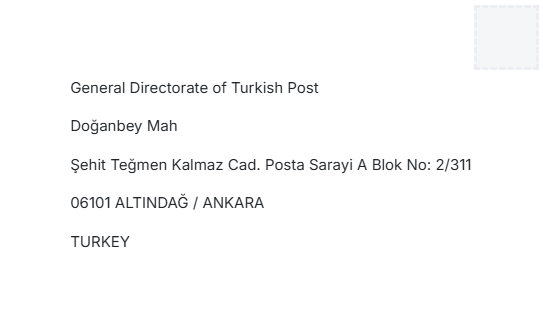
Address Example
Example of standardized Türkiye postal addresses
Country Info
Full Country Name: Republic of Türkiye
| Country Alpha-2 code | TR |
|---|---|
| Country Alpha-3 code | TUR |
| Numeric Code | 792 |
Time Zone
Türkiye Time Zone Details
| Time Zone | UTC | DST |
|---|---|---|
| Türkiye Time | UTC+3 | N/A |
Daylight saving time is not observed.
Official Language
Turkish is the official language. Kurdish and other minority languages are spoken regionally.
Fun Facts
- The total area of Türkiye is about 783,562 sq km / 302,535 sq miles, spanning both Europe and Asia. (CIA World Factbook)
- Türkiye has a coastline of approximately 7,200 km / 4,474 miles, bordering the Black Sea, Aegean Sea, and Mediterranean Sea. (CIA World Factbook)
- The terrain is mostly mountainous and plateau, with fertile coastal plains along the Aegean and Mediterranean. (CIA World Factbook)
Postal Authority
PTT (Posta ve Telgraf Teşkilatı) is the national postal service of Türkiye. It provides comprehensive mail and parcel delivery services, financial services, and logistics throughout all provinces of Türkiye.
Reference: https://www.ptt.gov.tr
Postal Code Format
In Türkiye, postal codes consist of 5 digits formatted as NNNNN. The code appears after the district and province names. Turkish addresses are written with street name, building number, neighborhood (mahalle), district (ilçe), and province (il).
Example: Atatürk Bulvarı No:123, Çankaya, Ankara 06420
Name Conventions
Population Names
In Türkiye, names follow a Western naming convention with given name(s) followed by the family name:
[opt: prof. title] [given name] [opt: middle name] [FAMILY NAME]
[given name] [opt: social honorific] [FAMILY NAME]
Examples:
- Mehmet Bay Yılmaz
- Ayşe Bayan Demir
- Dr. Ahmet Öztürk
- Zeynep Kaya
Turkish names use the Turkish alphabet which includes special characters: ç, ğ, ı, İ, ö, ş, ü.
Common titles include Bay (Mr.), Bayan (Mrs./Ms.), Hanım (lady, formal), Bey (gentleman, formal), and professional titles like Dr., or Prof., with social honorifics commonly placed after the forename.
Turkish naming law, established in 1934, mandated the adoption of surnames. Before this, many Turks used only given names with patronymics.
Turkish names are typically of Turkish, Arabic, or Persian origin, reflecting cultural and religious heritage.
Upon marriage, women traditionally adopt their husband's surname, though they may legally choose to keep their maiden name or use both.
The Turkish Civil Registry (Nüfus Müdürlüğü) manages name registration. Names must not be offensive, ridiculous, or contrary to moral values.
Compound names and multiple given names are less common than in some other cultures.
Organizational Names
Turkish businesses must register with the Trade Registry Office. Common legal entity designations include:
- A.Ş. (Anonim Şirket) – Joint stock company
- Ltd. Şti. (Limited Şirket) – Limited liability company
- Kol. Şti. (Kolektif Şirket) – General partnership
- Kom. Şti. (Komandit Şirket) – Limited partnership
- Şahıs Şirketi – Sole proprietorship
Company names must be unique and not misleading. The legal designation typically appears at the end of the company name.