






This guide provides a comprehensive overview of South Korea address formatting, postal code structures, and localization practices. It includes information on postal services, languages, time zones, and address validation standards across South Korea.
Address Format
Structure for standardized South Korea postal addresses:
Hangeul, Korean Address Format:
- Country
- AdministrativeArea Locality Thoroughfare PremisesNumber
- DependentLocality Building SubPremises SubPremisesLevel OR PostBoxType PostBoxNumber
- Organization
- Addressee
- PostalCode
English, Western Address Format:
- Addressee
- Organization
- DependentLocality Building SubPremises SubPremisesLevel OR PostBoxType PostBoxNumber
- PremisesNumber Thoroughfare Locality AdministrativeArea
- Country
- PostalCode
Address Verification Data
South Korea postal addresses verification data
| Available | Yes |
| Does the country use postal codes? | Yes |
| PO Box Indicator | 중앙 사서함, CPO Box, 사서함, PO Box |
| ISO-2-Code | KR |
| ISO-3-Code | KOR |
| Phonecode | 82 |
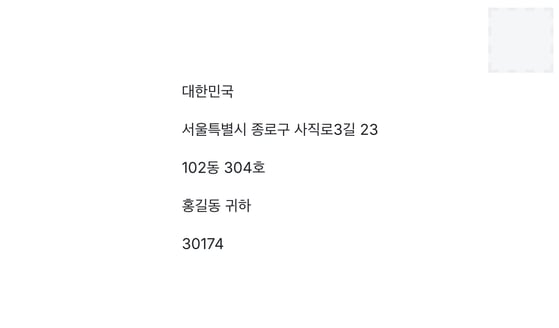
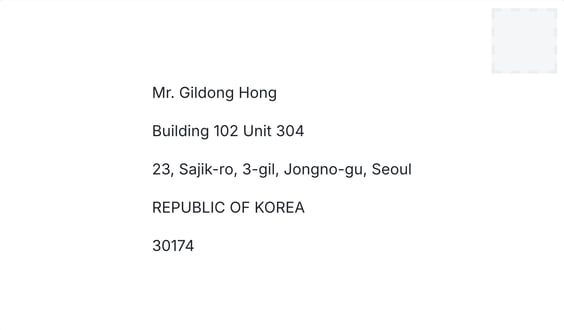
Address Example
Example of standardized South Korea postal addresses
Hangeul
English
Country Info
Full Country Name: South Korea
| Country Alpha-2 code | KR |
|---|---|
| Country Alpha-3 code | KOR |
| Numeric Code | 410 |
Time Zone
South Korea Time Zone Details
| Time Zone | UTC | DST |
|---|---|---|
| Korea Standard Time | UTC+9 | N/A |
Daylight saving time is not observed
Official Language
Korean is the official language, written using Hangul script and supplemented with Hanja (Chinese characters) in some contexts.
Fun Facts
- South Korea covers approximately 99,720 sq km / 38,502 sq miles, roughly the size of Indiana or Iceland, occupying the southern half of the Korean Peninsula. (CIA World Factbook)
- Located in East Asia on the southern half of the Korean Peninsula, South Korea shares the world’s most militarized border (the DMZ) with North Korea to the north, and is bordered by the Yellow Sea (west), the East Sea/Sea of Japan (east), and the Korea Strait (south). Its capital is Seoul. (CIA World Factbook)
- It is the world’s 12th-largest economy and one of only a handful of countries to transition from a low-income developing economy to a developed high income economy within a single generation — often called the “Miracle on the Han River.” (CIA World Factbook)
- The terrain is mostly hills and mountains with wide coastal plains in the west and south; Halla-san (1,950 m) on Jeju Island (a dormant shield volcano) is the highest point. Jeju Island’s volcanic landscape is a UNESCO World Heritage Site. (CIA World Factbook)
- South Korea is home to global brands including Samsung, LG, Hyundai, Kia, and SK, and its cultural exports (K-pop, K-drama, cinema) — collectively the “Korean Wave” or Hallyu — have global reach. (CIA World Factbook)
Postal Authority
Korea Post (우정사업본부) is the national postal service of South Korea, operated by the Ministry of Science and ICT. It provides domestic and international mail and parcel delivery, postal banking, insurance services, and logistics. Korea Post operates an extensive network across all provinces and metropolitan cities.
Reference: https://www.koreapost.go.kr/eng/
Postal Code Format
In South Korea, postal codes consist of 5 digits formatted as XXXXX. The new system was introduced in 2015, replacing the older 6-digit format. The code appears after the address details. Korean addresses are written from largest to smallest unit: province/city, district, street name, building number.
Example: 서울특별시 종로구 세종대로 209 (04512) or Seoul Jongno-gu Sejong-daero 209 (04512)
Name Conventions
Population Names
In South Korea, names follow the Eastern naming convention with family name preceding given name. The structure is:
[FAMILY NAME] [given name] [opt: titles]
Examples:
- 김민준 (Kim Min-jun)
- 이서연 교수 (Lee Seo-yeon Gyosu)
- 박지훈 (Park Ji-hoon)
- Park Joon-ho mit Park Sun-young (dual name, i.e., married couple)
Korean names are typically written in Hangul or Hanja characters, consisting of three syllables: one for the family name and two for the given name. Some given names may be one syllable.
When romanized, given names may be hyphenated (Min-jun) or written as one word (Minjun). Family names are capitalized (KIM Min-jun) in some formal contexts.
Common family names include Kim (김), Lee/Yi (이), Park (박), Choi (최), and Jung/Jeong (정).
Honorifics are crucial in Korean culture. Common ones include -씨 (-ssi, neutral), -님 (-nim, respectful), and titles like 선생님 (seonsaengnim, teacher/doctor), Baksa (Dr.) or Gyosu (professor).
Upon marriage, Korean women traditionally retain their maiden names, though they may informally use their husband's family name in social contexts.
Generational names (dolimja) may be shared among siblings or cousins, with one syllable of the given name being the same.
Organizational Names
South Korean businesses must register with the Korean Intellectual Property Office (KIPO) or local authorities. Common legal entity designations include:
- 주식회사 (Jusikhoesa or Co., Ltd.) – Stock company
- 유한회사 (Yuhanhoesa or Ltd.) – Limited liability company
- 합명회사 (Hapmyeonghoesa) – General partnership
- 합자회사 (Hapjahoesa) – Limited partnership
- 유한책임회사 (Yuhan Chaegim Hoesa or LLC) – Limited liability company
Company names must be unique and can be written in Korean (Hangul/Hanja) or English. The legal designation typically appears at the beginning of the formal company name in Korean contexts.