






This guide provides a comprehensive overview of South Africa address formatting, postal code structures, and localization practices. It includes information on postal services, languages, time zones, and address validation standards across South Africa.
Address Format
Structure for standardized South Africa postal addresses:
- Organization
- SubPremises SubPremisesLevel SubBuilding Building
- PremisesType PremisesNumber Thoroughfare DependentThoroughfare
- PostBoxType PostBoxNumber
- DependentLocality
- Locality
- PostalCode
- Country
Address Verification Data
South Africa postal addresses verification data
| Available | Yes |
| Does the country use postal codes? | Yes |
| PO Box Indicator | PO Box, Private Bag, Poste Restante |
| ISO-2-Code | ZA |
| ISO-3-Code | ZAF |
| Phonecode | 27 |
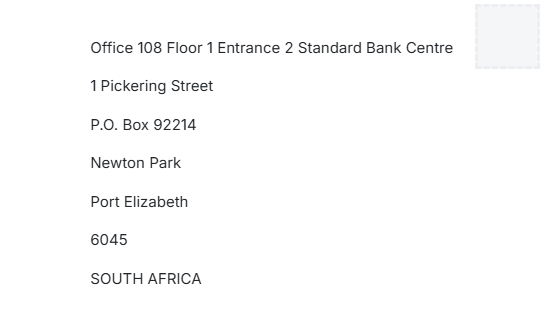
Address Example
Example of standardized South Africa postal addresses
Country Info
Full Country Name: South Africa
| Country Alpha-2 code | ZA |
|---|---|
| Country Alpha-3 code | ZAF |
| Numeric Code | 710 |
Time Zone
South Africa Time Zone Details
| Time Zone | UTC | DST |
|---|---|---|
| South Africa Standard Time | UTC+2 | N/A |
Daylight saving time is not observed.
Official Language
South Africa has 11 official languages: Zulu, Xhosa, Afrikaans, English, Northern Sotho, Tswana, Southern Sotho, Tsonga, Swazi, Venda, and Southern Ndebele.
Fun Facts
- The total area of South Africa is about 1,219,090 sq km / 470,693 sq miles. (CIA World Factbook)
- South Africa has a coastline of approximately 2,798 km / 1,739 miles, along both the Atlantic and Indian Oceans. (CIA World Factbook)
- The terrain is diverse, including high plateaus, mountains, savannas, and coastal plains. (CIA World Factbook)
Postal Authority
South African Post Office (SAPO) is the national postal service of South Africa. It provides mail and parcel delivery services, financial services, and retail services throughout all nine provinces, including urban and rural areas.
Reference: https://www.postoffice.co.za
Name Conventions
Population Names
In South Africa, naming conventions vary significantly by cultural and ethnic background, reflecting the country's diversity. Common structures include:
- [opt: title] [given name] [opt: middle name(s)] [FAMILY NAME]
- [African given name] [clan name/surname]
Examples:
- Pieter du Rand
- Ms. Zanele Dlamini
- Anna van der Merwe-Jacobs
- Dr. Thabo Mbeki and Dr. Nomsa Mbeki
- Nomsa Khumalo
South African names reflect the country's multicultural heritage including African, Afrikaans, English, and other traditions.
African names often carry significant meaning and may reference circumstances of birth, family history, or aspirations. Clan names are important in many African cultures.
Afrikaans names often include prefixes like "van der," "du," "de," "le," which are considered part of the surname.
Many South Africans have English, Afrikaans, or indigenous African given names, or combinations thereof.
Common titles include Mr., Mrs., Ms., Dr., Prof., and traditional titles like Chief, Induna, or Nkosi.
Upon marriage, practices vary widely: some women adopt their husband's surname, some hyphenate, and many retain their maiden names.
The Department of Home Affairs manages birth registration. Names should not be offensive or cause practical difficulties.
Organizational Names
South African businesses must register with the Companies and Intellectual Property Commission (CIPC). Common legal entity designations include:
- (Pty) Ltd – Proprietary limited company
- Ltd – Public company
- Inc. – Incorporated (non-profit)
- CC – Close corporation (no longer available for new registrations)
- SOC Ltd – State-owned company
Company names must be unique, not misleading, and not offensive. Names can be in any of the 11 official languages. The legal designation typically appears in parentheses at the end of the company name.