







This guide provides a comprehensive overview of Serbia address formatting, postal code structures, and localization practices. It includes information on postal services, languages, time zones, and address validation standards across Serbia.
Address Format
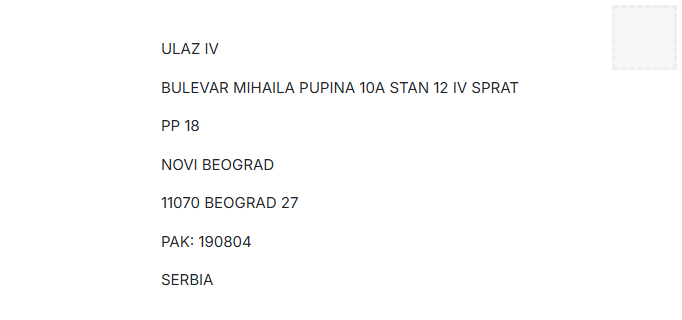
Structure for standardized Serbia postal addresses:
- Organization
- Building SubBuilding
- Thoroughfare PremisesNumber SubPremises SubPremisesLevel
- PostBoxType PostBoxNumber
- Locality
- (old) PostalCode PostOfficeName
- (PAK) PostalCode
- Country
Address Verification Data
Serbia postal addresses verification data
| Available | Yes |
| Does the country use postal codes? | Yes |
| PO Box Indicator | ПП, PP, PosteRestante, Војна Пошта, Vojna Pošta |
| ISO-2-Code | SR |
| ISO-3-Code | SRB |
| Phonecode | 381 |
Address Example
Example of standardized Serbia postal addresses
Country Info
Full Country Name: Republic of Serbia
| Country Alpha-2 code | SR |
|---|---|
| Country Alpha-3 code | SRB |
| Numeric Code | 688 |
Time Zone
Serbia Time Zone Details
| Time Zone | UTC | DST |
|---|---|---|
| Central European Time | UTC+1 | UTC+2 |
Official Language
Serbian is the official language, written in both Cyrillic and Latin scripts. Hungarian, Slovak, Romanian, and other languages are recognized in regions with minority populations.
Fun Facts
- The total area of Serbia is about 77,474 sq km / 29,913 sq miles. (CIA World Factbook)
- Serbia is landlocked, bordered by Hungary, Romania, Bulgaria, North Macedonia, Croatia, Bosnia and Herzegovina, and Montenegro. (CIA World Factbook)
- The terrain is diverse, with fertile plains in the north (Vojvodina) and hills and mountains in central and southern regions. (CIA World Factbook)
Postal Authority
Pošta Srbije (Serbian Post) is the national postal operator, providing mail, parcel, and financial services across all districts and municipalities, including both urban and rural areas.
Reference: https://www.posta.rs
Name Conventions
Population Names
Serbian names follow a Western Slavic naming convention where patronymic (middle given) names are rare:
[opt: title] [given name] [FAMILY NAME]
Examples:
- Miloš Jovanović
- Dr. Jelena Petrović
- Dipl. Ing. Stefan Nikolić
- Gospodin Marko Petrović i Gospođa Jelena Petrović
In legal documents, Eastern order is used to preserve alphabetic order. Common surname endings include -ić (most common), -ović, -ević, -ski, and -vić. Patronymic forms exist but are not commonly used in modern times. Titles include Gospodin (Mr.), Gospođa (Mrs.), Dr., and Prof. Middle names and dual surnames are uncommon.
Organizational Names
Serbian business entities include:
- d.o.o. (društvo sa ograničenom odgovornošću) – Limited liability company
- a.d. (akcionarsko društvo) – Joint stock company
- preduzetnik – Sole proprietorship
Businesses are registered with the Serbian Business Registers Agency (APR).