






This guide provides a comprehensive overview of Philippines address formatting, postal code structures, and localization practices. It includes information on postal services, languages, time zones, and address validation standards across Philippines.
Address Format
Structure for standardized Philippines postal addresses:
- Organization
- SubPremises SubPremisesLevel Building
- PremisesNumber Thoroughfare DependentThoroughfare DoubleDependentLocality
- PostBoxType PostBoxNumber
- PostOfficeLocation
- DependentLocality Locality
- PostalCode AdministrativeArea
- Country
Address Verification Data
Philippines postal addresses verification data
| Available | Yes |
| Does the country use postal codes? | Yes |
| PO Box Indicator | PO Box |
| ISO-2-Code | PH |
| ISO-3-Code | PHL |
| Phonecode | 63 |
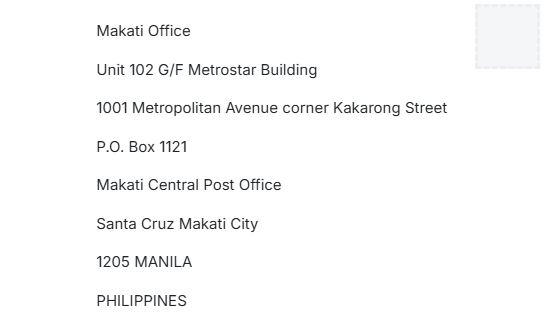
Address Example
Example of standardized Philippines postal addresses
Country Info
Full Country Name: Republic of the Philippines
| Country Alpha-2 code | PH |
|---|---|
| Country Alpha-3 code | PHL |
| Numeric Code | 608 |
Time Zone
Philippine Time Zone Details
| Time Zone | UTC | DST |
|---|---|---|
| Philippine Time | UTC+8 | N/A |
Daylight saving time is not observed.
Official Language
Filipino (based on Tagalog) and English are the official languages. Over 170 languages are spoken, including Cebuano, Ilocano, Hiligaynon, Waray, and others.
Fun Facts
- The total area of the Philippines is about 300,000 sq km / 115,831 sq miles, consisting of more than 7,600 islands. (CIA World Factbook)
- The Philippines has a coastline of approximately 36,289 km / 22,549 miles, one of the longest in the world. (CIA World Factbook)
- The terrain is mostly mountainous with narrow coastal plains, and many active volcanoes across the islands. (CIA World Factbook)
Postal Authority
Philippine Postal Corporation (PHLPost) is the national postal service of the Philippines. It provides mail and parcel delivery services, financial services, and logistics throughout the Philippine archipelago of over 7,000 islands.
Reference: https://phlpost.gov.ph/
Postal Code Format
In the Philippines, postal codes consist of 4 digits formatted as NNNN. The code appears after the city/municipality and province. Philippine addresses are written with house number and street, barangay (village), city/municipality, province, and postal code.
Example: 123 Rizal Avenue, Barangay San Miguel, Manila, 1005 Metro Manila
Name Conventions
Population Names
In the Philippines, names follow Spanish-influenced conventions due to colonial history, with given name(s) followed by maternal and paternal surnames:
[opt: title] [given name] [opt: middle name/maternal surname] [paternal FAMILY NAME]
Examples:
- Mr. Jose Rizal Mercado
- Ms. Maria Clara Santos
- Dr. Juan dela Cruz
- Ana Marie Reyes Garcia
Filipino names typically follow Western/Spanish conventions with given name first, followed by one or more family names.
The middle name traditionally represents the mother's maiden surname, while the last name is the father's surname.
Common titles include Mr., Mrs., Ms., Ginoo (Mr.), Ginang (Mrs.), and professional titles like Dr., Atty. (Attorney), Engr. (Engineer).
Spanish particles like "de," "del," "dela," "de los" (meaning "of" or "from") may appear in surnames, often indicating Spanish colonial heritage.
Upon marriage, women traditionally adopt their husband's surname and may drop their maternal surname, use it as a middle name, or hyphenate.
Many Filipinos have nicknames (palayaw) used in daily life, which may be diminutives, contractions, or unrelated to their official names.
Filipino naming law requires a given name and surname. Names should not be offensive, ridiculous, or extremely difficult to pronounce.
Chinese Filipino families often have both Chinese and Spanish/Filipino names.
Organizational Names
Philippine businesses must register with the Securities and Exchange Commission (SEC) or Department of Trade and Industry (DTI). Common legal entity designations include:
- Corporation or Corp. - Stock corporation
- Inc. (Incorporated) - Stock corporation
- Co. (Company) - Partnership or corporation
- OPC (One Person Corporation) - Single shareholder corporation
- Partnership - General or limited partnership
Company names must be unique and distinguishable from existing companies. Names should not be identical or confusingly similar to registered businesses. The legal designation typically appears at the end of the company name.