






This guide provides a comprehensive overview of Norway address formatting, postal code structures, and localization practices. It includes information on postal services, languages, time zones, and address validation standards across Norway.
Address Format
Structure for standardized Norway postal addresses:
- Organization
- Thoroughfare PremisesNumber Building SubPremises SubPremisesLevel
- PostBoxType PostBoxNumber
- PostalCode Locality
- Country
Address Verification Data
Norway postal addresses verification data
| Available | Yes |
| Does the country use postal codes? | Yes |
| PO Box Indicator | Postboks, PO Box |
| ISO-2-Code | NO |
| ISO-3-Code | NOR |
| Phonecode | 47 |
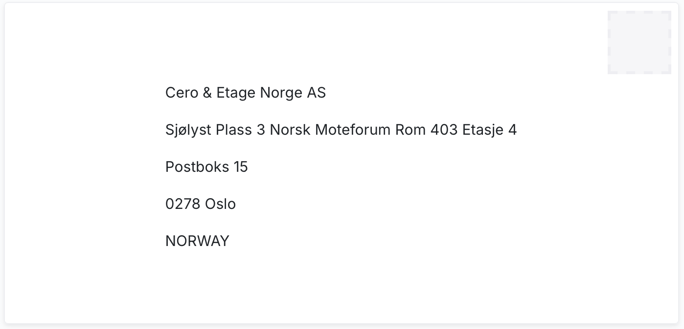
Address Example
Example of standardized Norway postal addresses
Country Info
Full Country Name: Kingdom of Norway
| Country Alpha-2 code | NO |
|---|---|
| Country Alpha-3 code | NOR |
| Numeric Code | 578 |
Time Zone
Norway Time Zone Details
| Time Zone | UTC | DST |
|---|---|---|
| Central European Time | UTC+1 | UTC+2 |
Official Language
Norwegian (in two forms: Bokmål and Nynorsk) is the official language. Sami languages are also recognized as official in certain regions.
Fun Facts
- The total area of Norway is about 323,802 sq km / 125,021 sq miles, including its mainland and Arctic islands such as Svalbard. (CIA World Factbook)
- Norway has an exceptionally long coastline of about 25,148 km / 15,626 miles, largely due to its fjords and islands. (CIA World Factbook)
- The terrain is mostly mountainous, with glaciers, deep fjords, and a cold climate in the north and at high elevations. (CIA World Factbook)
Postal Authority
Posten Norge (Norway Post) is the national postal service of Norway. It provides comprehensive mail and parcel delivery services, logistics solutions, and ecommerce support throughout Norway, including remote areas.
Reference: https://www.posten.no
Name Conventions
Population Names
In Norway, names follow the Western naming convention with given name(s) preceding the family name:
[opt: title] [given name] [opt: middle name(s)] [FAMILY NAME] [uncommon opt: suffix]
Examples:
- Ole HANSEN
- Kari JOHANSEN
- Dr. Erik ANDERSEN
- ISAKSEN, Torbjørn Ole
Norwegian names use the Latin alphabet with the additional letters æ, ø, and å.
Common titles include Herr (Mr., less common in modern use), Fru (Mrs.), and Frøken (Miss, archaic). Professional titles like Dr. and Prof. are used.
Norwegian surnames historically were patronymic (ending in -sen, -son, or -datter), but became hereditary family names in the early 20th century.
Upon marriage, either spouse may keep their surname, adopt their partner's surname, or both may use a hyphenated combination.
Norwegian naming law allows individuals to choose or create surnames, though certain restrictions apply to prevent confusion or offense.
Traditional Norwegian farm names (gårdsnavn) may also be used as surnames, often referring to the family's ancestral farm.
Organizational Names
Norwegian businesses must register with the Brønnøysund Register Centre. Common legal entity designations include:
- AS (Aksjeselskap) – Private limited company
- ASA (Allmennaksjeselskap) – Public limited company
- ANS (Ansvarlig selskap) – General partnership
- DA (Selskap med delt ansvar) – Limited partnership
- BA (Selskap med begrenset ansvar) – Limited liability company
Company names must be distinguishable from existing companies and cannot be misleading. The legal designation typically appears at the end of the company name.