






This guide provides a comprehensive overview of Nigeria address formatting, postal code structures, and localization practices. It includes information on postal services, languages, time zones, and address validation standards across Nigeria.
Address Format
Structure for standardized Nigeria postal addresses:
- Organization
- SubPremises SubPremisesLevel SubBuilding Building
- PremisesType PremisesNumber Thoroughfare DependentThoroughfare
- PostBoxType PostBoxNumber
- DependentLocality
- Locality PostalCode
- AdministrativeArea
- Country
Address Verification Data
Nigeria postal addresses verification data
| Available | Yes |
| Does the country use postal codes? | Yes |
| PO Box Indicator | PO Box, PMB, Post Restante |
| ISO-2-Code | NG |
| ISO-3-Code | NGA |
| Phonecode | 234 |
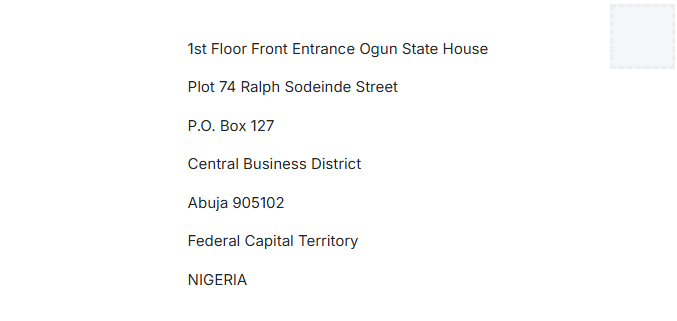
Address Example
Example of standardized Nigeria postal addresses
Country Info
Full Country Name: Federal Republic of Nigeria
| Country Alpha-2 code | NG |
|---|---|
| Country Alpha-3 code | NGA |
| Numeric Code | 566 |
Time Zone
Nigeria Time Zone Details
| Time Zone | UTC | DST |
|---|---|---|
| West Africa Time | UTC+1 | N/A |
Daylight saving time is not observed.
Official Language
English is the official language. Nigeria has over 500 indigenous languages, with Hausa, Yoruba, and Igbo being the most widely spoken.
Fun Facts
- The total area of Nigeria is about 923,768 sq km / 356,669 sq miles. (CIA World Factbook)
- Nigeria has a coastline of approximately 853 km / 530 miles along the Gulf of Guinea. (CIA World Factbook)
- The population is over 220 million and rapidly growing, making it the most populous country in Africa. (CIA World Factbook)
- The terrain is varied, including coastal plains, tropical forests, savannas, and semi-arid regions in the north. (CIA World Factbook)
Postal Authority
Nigerian Postal Service (NIPOST) is the national postal operator, providing mail and parcel delivery services across all 36 states and the Federal Capital Territory. NIPOST operates numerous post offices in urban and rural areas.
Reference: https://nipost.gov.ng
Name Conventions
Population Names
Nigerian naming conventions vary widely across its hundreds of ethnic groups. Common patterns from most prominent groups include:
- Yoruba: Names often have meanings and may include family lineage names.
- Igbo: Names typically reflect circumstances of birth or ancestral connections.
- Hausa: Names follow Islamic conventions with Arabic influence.
Typical structure: [opt:title] [given name] [middle name] [FAMILY NAME]
Examples:
- Chidi Okonkwo
- Fatima Abubakar
- Oluwole Babba-Kut
- Chukwuma Moses Chinedu
- Dr. Chinedu & Mrs. Ngozi Okafor
- Alhaji Musa Bello and Hajiya Aisha Bello
Cultural titles like Chief, Alhaji and Alhaja are common, as well as Western style honorifics (Mr., Mrs., Ms.), and professional titles (Prof., Dr., Eng.).
Organizational Names
Nigerian businesses must include legal entity designations:
- Ltd – Limited – private company
- PLC – Public limited company
- Ent. – Enterprise
- Co. - Company
Businesses are registered with the Corporate Affairs Commission (CAC).