





This guide provides a comprehensive overview of Morocco address formatting, postal code structures, and localization practices. It includes information on postal services, languages, time zones, and address validation standards across Morocco.
Address Format
Structure for standardized Morocco postal addresses:
- Organization
- SubPremisesLevel SubPremises
- SubBuilding Building
- PremisesType PremisesNumber Thoroughfare
- PostBoxType PostBoxNumber
- DependentLocality
- PostalCode Locality
- Country
Address Verification Data
Morocco postal addresses verification data
| Available | Yes |
| Does the country use postal codes? | Yes |
| PO Box Indicator | Boîte Postale |
| ISO-2-Code | MA |
| ISO-3-Code | MAR |
| Phonecode | 212 |
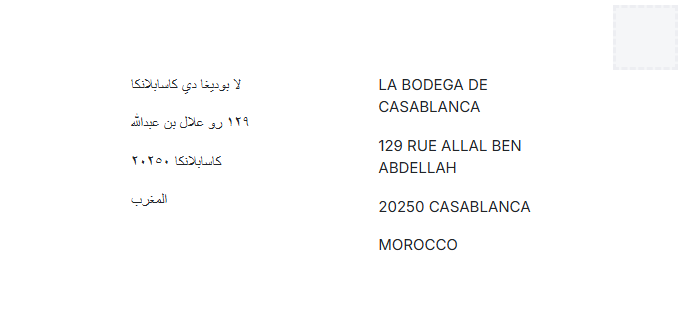
Address Example
Example of standardized Morocco postal addresses
Country Info
Full Country Name: Kingdom of Morocco
| Country Alpha-2 code | MA |
|---|---|
| Country Alpha-3 code | MAR |
| Numeric Code | 504 |
Time Zone
Kingdom of Morocco Time Zone Details
| Time Zone | UTC | DST |
|---|---|---|
| Western European Time | UTC+0 | UTC+1 |
Official Language
Arabic and Berber (Amazigh) are the official languages. Moroccan Arabic (Darija) is widely spoken. French is commonly used in business, government, and education.
Fun Facts
- The total area of Morocco is about 446,550 sq km / 172,414 sq miles (excluding Western Sahara). (CIA World Factbook)
- Morocco has a coastline of approximately 1,835 km / 1,140 miles, along both the Atlantic Ocean and the Mediterranean Sea. (CIA World Factbook)
- The terrain is diverse, including the Atlas Mountains, coastal plains, and parts of the Sahara Desert. (CIA World Factbook)
Postal Authority
Barid Al-Maghrib (Poste Maroc) is Morocco's national postal service, providing mail and parcel delivery, financial services, and digital solutions across all regions, including urban centers and rural areas.
Reference: https://www.poste.ma
Name Conventions
Population Names
Moroccan names follow Arabic naming conventions with Berber and French influences:
[opt: titles] [given name] [father's name] [FAMILY NAME]
Examples:
- Sayyid Youssef Benali
- Amina El Fassi
- Dr. Youssef Benali et Prof. Amina El Fassi
- Monsieur le Docteur Youssef Benali et Madame la Professeure Amina El Fassi
Titles and honorifics include: Si/Sidi (Mr.), Lalla (Mrs./Ms.), Dr., Prof., and Eng., as well as religious titles such as Sheikh and Faqih. Many families use "Ben" (son of) or "Bint" (daughter of) in traditional naming as surname prefixes. Middle names exist, but are not commonly used on official documents and IDs.
Organizational Names
Moroccan business entities include:
- SARL (Société à Responsabilité Limitée) - Private limited company
- SA (Société Anonyme) - Public company
- SNC (Société en Nom Collectif) - General partnership
Businesses are registered with the Office Marocain de la Propriété Industrielle et Commerciale (OMPIC).