







This guide provides a comprehensive overview of Japan address formatting, postal code structures, and localization practices. It includes information on postal services, languages, time zones, and address validation standards across Japan.
Address Format
Structure for standardized Japan postal addresses:
Kanji Address Format:
- Organization
- Thoroughfare PremisesNumber SubBuilding SubPremisesLevel SubPremises
- PostBoxType PostBoxNumber
- PostalCode Locality
- Country
Romaji (Roman) Address Format:
- Organization-PostBox (both optional)
- DoubleDependentLocality – Building – PremisesNumber DependentLocality, Locality, AdministrativeArea PostalCode
- Country
Address Verification Data
Japan postal addresses verification data
| Available | Yes |
| Does the country use postal codes? | Yes |
| PO Box Indicator |
私書箱, PO Box |
| ISO-2-Code | JP |
| ISO-3-Code | JPN |
| Phonecode | 81 |
Address Example
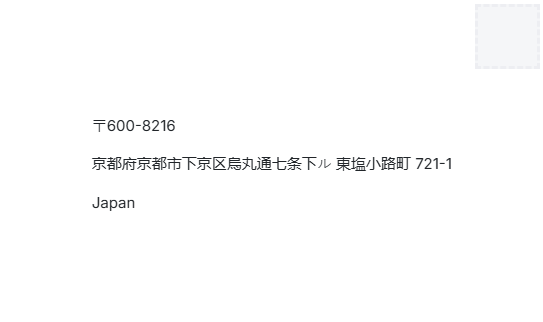
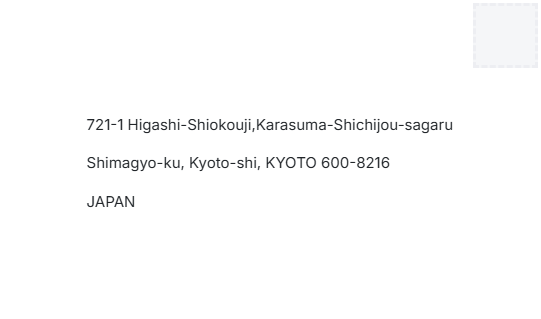
Example of standardized Japan postal addresses
Kanji
Romaji
Country Info
Full Country Name: Japan
| Country Alpha-2 code | JP |
|---|---|
| Country Alpha-3 code | JPN |
| Numeric Code | 81 |
Time Zone
Japan Time Zone Details
| Time Zone | UTC | DST |
|---|---|---|
| Japan Standard Time | UTC+9 | N/A |
Daylight saving time is not observed.
Official Language
Japanese is the official language. Regional languages and dialects include Ryukyuan languages spoken in Okinawa Prefecture.
Fun Facts
- The total area of Japan is about 377,915 sq km / 145,937 sq miles, consisting of four main islands and many smaller ones. (CIA World Factbook)
- Japan has a coastline of approximately 29,751 km / 18,486 miles, one of the longest in the world due to its island geography. (CIA World Factbook)
- The terrain is mostly mountainous and forested, with limited flat land for cities and agriculture. (CIA World Factbook)
Postal Authority
Japan Post (日本郵便株式会社, Nippon Yūbin Kabushiki-gaisha) is the national postal service of Japan. It provides domestic and international mail and parcel delivery, postal banking services, and logistics. Japan Post operates an extensive network of post offices throughout all prefectures, including rural and island communities.
Reference: https://www.post.japanpost.jp
Postal Code Format
In Japan, postal codes consist of 7 digits formatted as XXX-XXXX. The code precedes the prefecture name and address. Japanese addresses are written from largest geographic unit to smallest: prefecture, city/ward, neighborhood, block, building number.
Example: 〒100-8994 東京都千代田区丸の内2-7-2 (Tokyo-to Chiyoda-ku Marunouchi 2-7-2)
Name Conventions
Population Names
In Japan, names traditionally follow the Eastern naming convention with family name preceding given name. The structure is:
[FAMILY NAME] [given name] [opt: title]
Examples:
- 田中 太郎 (Tanaka Taro)
- 田中太郎さん (Tanaka Tarō-san) - honorific is attached to the forename
- 佐藤 花子 (Sato Hanako)
- 鈴木 一郎 (Suzuki Ichiro)
- 山田 美咲 (Yamada Misaki)
Japanese names are typically written in kanji characters, though hiragana and katakana may also be used. When romanized, family names are often written in all capitals to avoid confusion (TANAKA Taro).
Honorifics such as -san (Mr./Ms./Mrs.), -sama (more respectful), -kun (informal masculine), and -chan (informal feminine/diminutive) are commonly used after given names.
Upon marriage, it is customary (and legally required under current law) for one spouse to adopt the other's family name, typically the wife adopting the husband's name, though the reverse is legally permissible.
Middle names are not traditionally used in Japan, though dual citizenship holders may have them from foreign heritage.
Organizational Names
Japanese businesses must register with the Legal Affairs Bureau and include appropriate legal designations. Common suffixes include:
- 株式会社 (Kabushiki-gaisha or K.K.) – Stock company
- 有限会社 (Yugen-gaisha or Y.K.) – Limited company (no longer formed but existing ones remain)
- 合同会社 (Godo-gaisha or G.K.) – Limited liability company
- 合名会社 (Gomei-gaisha) – General partnership
- 合資会社 (Goshi-gaisha) – Limited partnership
Company names can be written in kanji, hiragana, katakana, or romaji (Roman letters). The legal designation may appear before or after the company name.