








This guide provides a comprehensive overview of Indonesia address formatting, postal code structures, and localization practices. It includes information on postal services, languages, time zones, and address validation standards across Indonesia.
Address Format
Structure for standardized Indonesia postal addresses:
- Organization
- Building SubBuilding SubPremises SubPremisesLevel
- Thoroughfare PremisesType PremisesNumber
- DoubleDependentLocality DependentLocality
- Locality - PostalCode
- Country
Address Verification Data
Indonesia postal addresses verification data
| Available | Yes |
| Does the country use postal codes? | Yes |
| PO Box Indicator | Kotak Pos, PO Box |
| ISO-2-Code | ID |
| ISO-3-Code | IDN |
| Phonecode | 62 |
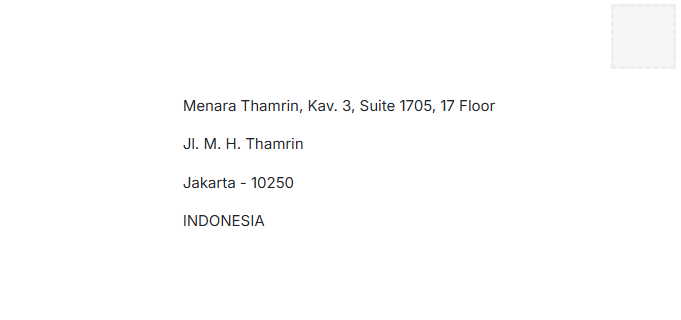
Address Example
Example of standardized Indonesia postal addresses
Country Info
Full Country Name: Republic of Indonesia
| Country Alpha-2 code | ID |
|---|---|
| Country Alpha-3 code | IDN |
| Numeric Code | 360 |
Time Zone
Indonesia Time Zone Details
| Time Zone | UTC | DST |
|---|---|---|
| Western Indonesia Time | UTC+7 | N/A |
| Central Indonesia Time | UTC+8 | N/A |
| Eastern Indonesia Time | UTC+9 | N/A |
Daylight saving time is not observed.
Official Language
Indonesian (Bahasa Indonesia) is the sole official language. Hundreds of regional languages are also spoken across the archipelago, including Javanese, Sundanese, Madurese, Minangkabau, Batak, Balinese, and many others.
Fun Facts
- The total area of Indonesia is about 1,904,569 sq km / 735,358 sq miles, making it the world’s largest archipelagic state. (CIA World Factbook)
- Indonesia comprises roughly 17,000 islands straddling the equator in Southeast Asia and shares land borders with Malaysia, Papua New Guinea, and Timor-Leste. (CIA World Factbook)
- Indonesia is the world’s fourth most populous country and the largest Muslim majority of any nation. (CIA World Factbook)
- The terrain is mostly coastal lowlands with mountainous interiors on the larger islands and many active volcanoes; Java is the most populous island. (CIA World Factbook)
Postal Authority
Pos Indonesia (PT Pos Indonesia) is the national postal operator of the Republic of Indonesia and the country’s Designated Postal Operator under the Universal Postal Union. It is a state-owned enterprise that provides domestic and international mail, parcel, logistics, and financial services across all 38 provinces.
Reference: https://www.posindonesia.co.id
Postal Code Format
In Indonesia, postal codes consist of 5 digits formatted as NNNNN. The postal code typically appears after the city or locality name, often separated by a dash. Indonesian addresses are written with building details, street name (jalan / Jl.), kelurahan or desa (urban or rural sub-district) and kecamatan (district), city or kabupaten with postal code, province, and country.
Example: Jakarta - 10250
Name Conventions
Population Names
In Indonesia, naming conventions vary widely by ethnic group and tradition. Many Indonesians use a single name, while others use a given name plus family name, patronymic, or clan name:
- [given name]
- [given name] [additional name(s)]
- [given name] [FAMILY NAME] (varies by ethnicity)
Examples:
- Suharto (single name, Javanese)
- Megawati Sukarnoputri (given name + patronymic)
- Ahmad Dahlan (Arabic-style name where additional names can sometimes be used as a surname)
- Budi Santoso (given name + family name)
- Ni Luh Putu Eka (Balinese name with gender and generational titles)
Many Indonesians, particularly Javanese and Sundanese, traditionally use only a single name (mononym). Others use a given name followed by a family name, a patronymic, or, in the case of Batak families, a clan name (marga) such as Sitorus, Marpaung, or Nasution. Minangkabau people follow a matrilineal tradition. Chinese-Indonesian families historically Indonesianized their surnames.
Balinese names commonly include a birth-order indicator: Wayan or Putu (first-born), Made or Kadek (second), Nyoman or Komang (third), and Ketut (fourth), often preceded by I (male) or Ni (female).
Common honorifics include Bapak / Pak (Mr.), Ibu / Bu (Mrs./Madam), Mas (older brother or younger man), Mbak (woman, peer), and Saudara / Saudari (sibling or peer). Professional and academic titles such as Dr., Prof., Ir. (Insinyur, engineer), Drs. / Dra. (Doctorandus / Doctoranda), and H. / Hj. (Haji / Hajjah, used by those who have completed the pilgrimage to Mecca) are also common.
Upon marriage, Indonesian women generally retain their birth names. Some women adopt their husband’s surname socially, especially in urban or professional contexts.
Names are written in Latin script. Many Indonesian names are drawn from Sanskrit, Arabic, or local language roots and often carry meanings related to virtues, nature, or auspicious qualities.
Organizational Names
Indonesian businesses must register with the Ministry of Law and Human Rights (Kemenkumham), with business licensing handled through the Online Single Submission (OSS) system. Common legal entity designations include:
- PT (Perseroan Terbatas) – Limited liability company, the most common form
- PT Tbk (Perseroan Terbatas Terbuka) – Publicly listed company
- CV (Commanditaire Vennootschap) – Limited partnership
- Firma (Fa.) – General Partnership
- UD (Usaha Dagang) – Trading business / Sole proprietorship
- Yayasan – Foundation
- Koperasi – Cooperative
Company names must be unique within the Companies Register, must not be misleading, and must not suggest unauthorized affiliation with the state. The legal entity designation typically appears at the start of the company name (for example, “PT Bank Mandiri Tbk”).