







This guide provides a comprehensive overview of India address formatting, postal code structures, and localization practices. It includes information on postal services, languages, time zones, and address validation standards across India.
Address Format
Structure for standardized India postal addresses:
- Organization
- SubPremisesLevel SubPremises SubBuilding Building
- PremisesNumber Thoroughfare DependentThoroughfare
- PostBoxType PostBoxNumber
- DoubleDependentLocality
- DependentLocality
- Locality - PostalCode
- AdministrativeArea
- Country
Address Verification Data
India postal addresses verification data
| Available | Yes |
| Does the country use postal codes? | Yes |
| PO Box Indicator | PO Box, Poste Restante, Post Bag |
| ISO-2-Code | IN |
| ISO-3-Code | IND |
| Phonecode | 91 |
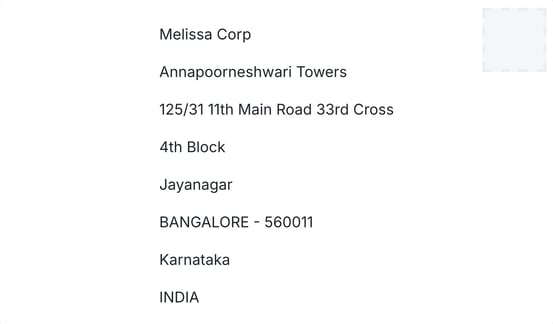
Address Example
Example of standardized India postal addresses
Country Info
Full Country Name: Republic of India
| Country Alpha-2 code | IN |
|---|---|
| Country Alpha-3 code | IND |
| Numeric Code | 356 |
Time Zone
India Time Zone Details
| Time Zone | UTC | DST |
|---|---|---|
| India Standard Time | UTC+5:30 | N/A |
Daylight saving time is not observed
Official Language
Hindi and English are the official languages at the national level. The Constitution recognizes 22 scheduled languages including Bengali, Telugu, Marathi, Tamil, Urdu, Gujarati, Malayalam, Kannada, Odia, Punjabi, and others. Individual states may have their own official languages.
Fun Facts
- The total area of India is about 3,287,263 sq km / 1,269,219 sq miles, making it the seventh-largest country in the world. (CIA World Factbook)
- India has a coastline of approximately 7,000 km / 4,350 miles, bordering the Arabian Sea, Indian Ocean, and Bay of Bengal. (CIA World Factbook)
- The population is over 1.4 billion, making it the most populous country in the world. (CIA World Factbook)
- The terrain is highly diverse, including the Himalayas in the north, plains, deserts, and tropical coastal regions. (CIA World Factbook)
Postal Authority
India Post (भारतीय डाक) is the national postal service operated by the Department of Posts under the Ministry of Communications. It is one of the world's most extensive postal networks, providing mail and parcel services, postal banking, insurance, and retail services across all states and union territories, including remote and rural areas.
Reference: https://www.indiapost.gov.in
Postal Code Format
In India, postal codes are called PIN (Postal Index Number) codes and consist of 6 digits. The first digit represents the region, the second digit represents the sub-region or circle, the third digit represents the sorting district, and the last three digits represent the specific post office. PIN codes appear after the city and state name.
Example: Mumbai, Maharashtra 400001
Name Conventions
Population Names
In India, naming conventions vary significantly by region, religion, and cultural background. However, a common structure includes:
[opt: title] [given name] [opt: middle name/father's name] [FAMILY NAME/surname]
Examples:
- Mr. Rajesh Kumar Sharma
- Smt. Priya Patel
- S. P. Balasubrahmanyam *
- Prof. Dr. Amit Singh
- Mrs. Lakshmi Rao
- Reddy Prasad (alternate format)
Many Indian names reflect religious and regional traditions. Hindu names often reference deities or Sanskrit words. Muslim names follow Arabic conventions. Sikh names typically include Singh (male) or Kaur (female) as middle names.
*In South India, patronymic naming is common, where a person's name includes their father's name or village name. For example, "S. Ramesh" where "S" stands for the father's name. On official documents the entire name, or initials only, can appear as a surname.
Common titles include Mr., Mrs., Ms., Dr., Prof., and Shri/Sri (respectful term for men), Smt./Srimati (married women), and Kumari (unmarried women).
After marriage, women may adopt their husband's family name, though this varies by region and personal choice. Some women retain their maiden names.
Names may be written in various Indian scripts (Devanagari, Tamil, Bengali, etc.) but are romanized for official documents using the Latin alphabet.
Organizational Names
Indian businesses must register with the Ministry of Corporate Affairs (MCA) or appropriate state authorities. Common legal entity designations include:
- Private Limited (Pvt. Ltd.) – Private limited company
- Limited (Ltd.) – Public limited company
- LLP – Limited liability partnership
- OPC – One person company
- Proprietorship – Sole proprietorship (no suffix required)
Company names must be unique, not identical or similar to existing companies, and cannot include words that suggest government affiliation without approval. Names may be in English, Hindi, or any regional language recognized by the Constitution.