






This guide provides a comprehensive overview of Greece address formatting, postal code structures, and localization practices. It includes information on postal services, languages, time zones, and address validation standards across Greece.
Address Format
Structure for standardized Greece postal addresses:
- Organization
- Building
- Thoroughfare PremisesNumber SubPremisesLevel SubPremises
- PostBoxType PostBoxNumber
- PostalCode Locality
- Country
Address Verification Data
Greece postal addresses verification data
| Available | Yes |
| Does the country use postal codes? | Yes |
| PO Box Indicator | Τ.Θ., T.Th., PO Box |
| ISO-2-Code | GR |
| ISO-3-Code | GRC |
| Phonecode | 30 |
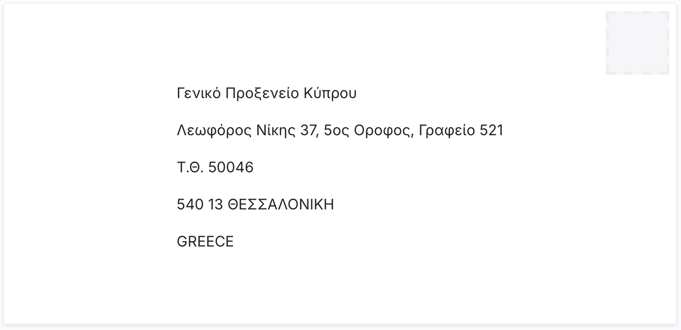
Address Example
Example of standardized Greece postal addresses
Country Info
Full Country Name: Hellenic Republic
| Country Alpha-2 code | GR |
|---|---|
| Country Alpha-3 code | GRC |
| Numeric Code | 300 |
Time Zone
Greece Time Zone Details
| Time Zone | UTC | DST |
|---|---|---|
| Eastern European Time | UTC+2 | UTC+3 |
Official Language
Greek is the official language.
Fun Facts
- The total area of Greece is about 131,957 sq km / 50,949 sq miles, including thousands of islands. (CIA World Factbook)
- Greece has a coastline of approximately 13,676 km / 8,498 miles, one of the longest in the world due to its many islands. (CIA World Factbook)
- The terrain is mostly mountainous, with ranges on the mainland and rugged islands, alongside limited fertile plains. (CIA World Factbook)
Postal Authority
Hellenic Post (ELTA - Ελληνικά Ταχυδρομεία) is the national postal service of Greece. It provides mail and parcel delivery services, financial services, and logistics throughout mainland Greece and the Greek islands.
Reference: https://www.elta.gr
Postal Code Format
In Greece, postal codes consist of 5 digits formatted as NNN NN (with a space). The first three digits represent the area, and the last two digits represent the delivery post office. The code appears before the city name.
Example: Λεωφόρος Αθηνών 123, 104 42 Αθήνα (Leoforos Athinon 123, 104 42 Athens)
Name Conventions
Population Names
In Greece, names follow a Western naming convention with given name(s) followed by the family name:
[opt: title] [given name] [opt: middle name/patronymic] [FAMILY NAME]
Examples:
- Κύριος Γιώργος Παπαδόπουλος (Mr. Georgios Papadopoulos)
- Κα Μαρία Αθανασίου (Mrs. Maria Athanasiou)
- Δρ. Νικόλαος Καραγιάννης (Dr. Nikolaos Karagiannis)
- Ελένη Βασιλείου (Eleni Vasiliou)
Greek names are written in the Greek alphabet (Ελληνικό αλφάβητο) and romanized for international use.
Common titles include Κος/Κύριος (Mr.), Κα/Κυρία (Mrs./Ms.), Δις (Miss, archaic), and professional titles like Δρ. (doctor), Καθ. (professor).
Greek surnames often have patronymic origins (ending in -opoulos, -ides, -akis, -ou) or refer to occupations, characteristics, or places.
Traditionally, women's surnames had feminine endings (e.g., -ou, -aina), though the masculine form is now commonly used.
Greek naming tradition includes naming children after grandparents. The first son is typically named after the paternal grandfather, the first daughter after the paternal grandmother.
Upon marriage, women traditionally adopted their husband's surname, but since 1983, they may keep their maiden name or use both.
Name days (ονομαστική εορτή) are significant in Greek culture, celebrating the saint after whom one is named.
Organizational Names
Greek businesses must register with GEMI (General Commercial Registry). Common legal entity designations include:
- Α.Ε. (Ανώνυμη Εταιρεία) – Public limited company
- Ε.Π.Ε. (Εταιρεία Περιορισμένης Ευθύνης) – Limited liability company
- Ο.Ε. (Ομόρρυθμη Εταιρεία) – General partnership
- Ε.Ε. (Ετερόρρυθμη Εταιρεία) – Limited partnership
- Ι.Κ.Ε. (Ιδιωτική Κεφαλαιουχική Εταιρεία) – Private capital company
Company names must be in Greek, though Latin transliterations may also be registered. Names must be unique and not misleading. The legal designation typically appears at the end of the company name.