







This guide provides a comprehensive overview of Ecuador address formatting, postal code structures, and localization practices. It includes information on postal services, languages, time zones, and address validation standards across Ecuador.
Address Format
Structure for standardized Ecuador postal addresses.
- Organization
- Building SubBuilding SubPremisesLevel, SubPremises
- Thoroughfare PremisesNumber DependentThoroughfare
- PostBoxType PostBoxNumber
- DependentLocality
- PostalCode Locality
- Country
Address Verification Data
Ecuador postal addresses verification data.
| Available: | Yes |
| Does the country use Postal Codes: | Yes |
| PO Box Indicator: | Apartado, Apartado Aéreo, Casilla Postal |
| ISO-2-Code: | EC |
| ISO-3-Code: | ECU |
| Phonecode: | 593 |
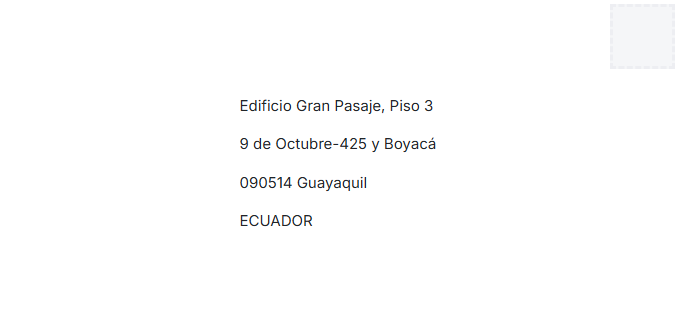
Address Example
Example of standardized Ecuador postal addresses.
Country Info
Full Country Name: Republic of Ecuador
| Country Alpha-2 code | EC |
|---|---|
| Country Alpha-3 code | ECU |
| Numeric Code | 218 |
Timezone
Ecuador Time Zone Details
| Time Zone | UTC | DST |
|---|---|---|
|
Ecuador Time |
UTC-5 | N/A |
|
Galápagos Time |
UTC-6 | N/A |
Official Language
Spanish is the official language of Ecuador. Under Article 2 of the 2008 Constitution, Spanish, Kichwa, and Shuar are official for intercultural relations, and other ancestral languages are in official use by indigenous peoples in their territories. Daylight saving time is not observed.
Fun Fact
- The total area of Ecuador is about 283,561 sq km / 109,484 sq miles. (CIA World Factbook)
- Ecuador sits on the equator in northwestern South America, bordered by Colombia and Peru, with a Pacific coastline and the Galápagos Islands roughly 1,000 km offshore. (CIA World Factbook)
- The country won independence from Spain in 1822 as part of Gran Colombia and became a fully sovereign republic in 1830. (CIA World Factbook)
- Natural hazards include earthquakes, landslides, and volcanic activity along the Andean volcanic belt, as well as floods and periodic tsunamis along the coast. (CIA World Factbook)
- Life expectancy averages around 78 years, reflecting steady gains in healthcare and living standards. (CIA World Factbook)
- The population is growing and urbanizing, with sizable indigenous and Afro-Ecuadorian communities in the Sierra and northern coastal regions. (CIA World Factbook)
- The terrain comprises four regions — Costa, Sierra, Oriente, and Insular (Galápagos) — with the equator running just north of the capital, Quito. (CIA World Factbook)
Postal Authority
Servicios Postales del Ecuador EP (SPE EP) is the national public postal operator of Ecuador. It was created by Executive Decree 1244 in 2020 to succeed Correos del Ecuador EP and guarantees continuity of the Universal Postal Service for domestic and international mail and parcel delivery across all provinces.
Reference: https://www.serviciopostal.gob.ec
Postal Code Format
In Ecuador, postal codes consist of 6 digits formatted as NNNNNN. The first two digits identify the province, the next two identify the canton, and the final two identify the local zone. The postal code appears before the city or locality name on the same line. Ecuadorian addresses are written with building details, the street name and number, postal code and city, and country.
Example: 170150 Quito
Name Conventions
Population Names
In Ecuador, names follow the standard Spanish naming convention with the given name(s) preceding the paternal and maternal surnames:
[opt: title] [given name(s)] [PATERNAL SURNAME] [MATERNAL SURNAME]
Examples:
- María Fernanda Pérez González
- Sr. Carlos Vega Mora
- Dra. Lucía Yamberla Tenesaca
- Ing. Juan Carlos Quishpe Chimbo
- Carlos Alfaro y Anita Pérez García
Official documents often include two given names (forenames).
The paternal surname (apellido paterno) inherits from the father and is used in everyday address; the maternal surname (apellido materno) inherits from the mother and is included in legal and formal contexts.
Common titles include Sr. (Señor), Sra. (Señora), Srta. (Señorita), and the respectful forms Don and Doña used with first names. Professional titles such as Dr. (Doctor), Lic. (Licenciado), Ing. (Ingeniero), Prof. (Profesor), Arq. (Arquitecto), and Abg. (Abogado) are commonly used.
Indigenous surnames are common throughout the Sierra and Oriente regions, particularly among Kichwa and Shuar communities. Examples include Yamberla, Tenesaca, Quishpe, Chimbo, Cabascango, Lema, and Tsenkush. Indigenous given names also appear alongside Spanish names.
Following Spanish-speaking tradition, women legally retain their birth surnames upon marriage. Socially, a woman may append “de [husband’s paternal surname]” (for example, María Pérez de López), though this practice has declined among younger generations.
Diacritical marks (á, é, í, ó, ú, ñ) are part of standard spellings and should be preserved.
Organizational Names:
Ecuadorian businesses must register with the Superintendencia de Compañías, Valores y Seguros (SCVS); cooperatives are regulated separately under the Superintendencia de Economía Popular y Solidaria (SEPS). Common legal entity designations include:
- C.A. – Compañía Anónima (Corporation)
- S.A. – Sociedad Anónima (Joint-Stock Company)
- Cía. Ltda. – Compañía de Responsabilidad Limitada (Limited Liability Company)
- S.A.S. – Sociedad por Acciones Simplificada (Simplified Joint-Stock Company)
- E.U.R.L. – Empresa Unipersonal de Responsabilidad Limitada (Single-Member LLC)
- Cooperativa – Cooperative Enterprise
Company names must be unique within the Commercial Registry, must not be misleading, and must not suggest unauthorized affiliation with the state. The legal entity designation typically appears at the end of the company name.