







This guide provides a comprehensive overview of China address formatting, postal code structures, and localization practices. It includes information on postal services, languages, time zones, and address validation standards across China.
Address Format
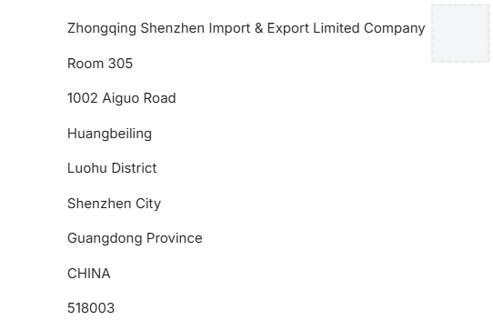
Structure for standardized China postal addresses:
- Organization
- SubPremisesType SubPremisesNumber
- PremisesNumber ThoroughfareName ThoroughfareTrailingType
- Locality
- SubAdministrativeArea
- AdministrativeArea
- SubNationalArea
- Country
- PostalCode
Address Verification Data
China postal addresses verification data
| Available | Yes |
| Does the country use postal codes? | Yes |
| PO Box Indicator |
邮政信箱, 存局候领, PO Box, Poste Restante |
| ISO-2-Code | CN |
| ISO-3-Code | CHN |
| Phonecode | 86 |
Address Example
Example of standardized China postal addresses
Country Info
Full Country Name: People's Republic of China
| Country Alpha-2 code | CN |
|---|---|
| Country Alpha-3 code | CHN |
| Numeric Code | 156 |
Time Zone
China Time Zone Details
| Time Zone | UTC | DST |
|---|---|---|
| China Standard Time | UTC+8 | N/A |
Daylight saving time is not observed
Official Language
Standard Mandarin Chinese (Putonghua) is the official language. Regional languages include Cantonese, Wu, Min, Hakka, and others. Ethnic minority languages are also recognized in autonomous regions.
Fun Facts
- The total area of China is about 9,596,961 sq km / 3,705,407 sq miles, making it one of the largest countries in the world. (CIA World Factbook)
- China has a coastline of approximately 14,500 km / 9,010 miles along the East China Sea, Yellow Sea, and South China Sea. (CIA World Factbook)
- The population is over 1.4 billion. (CIA World Factbook)
- The terrain is highly diverse, with mountains and plateaus (like the Tibetan Plateau) in the west and fertile plains and river valleys in the east. (CIA World Factbook)
Postal Authority
China Post (中国邮政, Zhōngguó Yóuzhèng) is the national postal service of the People's Republic of China. It provides comprehensive mail and parcel delivery services, postal savings banking, logistics, and e-commerce support. China Post operates one of the world's largest postal networks, serving all provinces, municipalities, and autonomous regions including remote areas.
Reference: http://www.chinapost.com.cn
Postal Code Format
In China, postal codes consist of 6 digits. The first two digits represent the province or municipality, the third digit represents the postal zone, and the last three digits represent the delivery office. Addresses are written from largest to smallest unit: province, city, district, street, building number.
Example: 100000 北京市东城区长安街1号 (Beijing Shi Dongcheng Qu Chang'an Jie 1 Hao)
Name Conventions
Population Names
In China, names follow the Eastern naming convention with family name preceding given name. The structure is:
[FAMILY NAME] [given name][opt: titles]
Examples:
- 王伟先生 (Wang Wei xiānsheng)
- 李娜 (Li Na)
- 张明 (Zhang Ming)
- 刘芳医生 (Liu Fang yīshēng)
Chinese names are written in Chinese characters (汉字, hanzi), typically two or three characters total. The family name is usually one character, while given names are usually one or two characters.
When romanized using Pinyin, the family name is often capitalized (WANG Wei) to distinguish it from the given name, though this varies.
Common honorifics include 先生 (xiānsheng, Mr.), 女士 (nǚshì, Ms./Mrs.), 小姐 (xiǎojiě, Miss, less common in mainland China), and 老师 (lǎoshī, teacher, used respectfully). Professional titles like yīshēng (Doctor) and jiàoshòu (Professor) are commonly used.
Chinese naming traditions are patrilineal, with children taking their father's family name. However, some families may use both parents' surnames, or in rare cases, the mother's surname.
Generation names (shared middle characters among siblings and cousins) are traditional but less common in modern times.
Organizational Names
Chinese businesses must register with the State Administration for Market Regulation (SAMR). Common legal entity designations include:
- 有限公司 (Yǒuxiàn Gōngsī or Ltd.) – Limited liability company
- 股份有限公司 (Gǔfèn Yǒuxiàn Gōngsī or Co., Ltd.) – Joint stock limited company
- 有限责任公司 (Yǒuxiàn Zérèn Gōngsī) – Limited liability company (alternative form)
- 个体工商户 (Gètǐ Gōngshāng Hù) – Individual industrial and commercial household
- 合伙企业 (Héhuǒ Qǐyè) – Partnership enterprise
Company names must include Chinese characters and be unique within their registration jurisdiction. Foreign-invested enterprises may also register English names. The legal designation typically appears at the end of the company name.