







This guide provides a comprehensive overview of Bosnia and Herzegovina address formatting, postal code structures, and localization practices. It includes information on postal services, languages, time zones, and address validation standards across Bosnia and Herzegovina.
Address Format
Structure for standardized Bosnia and Herzegovina postal addresses:
- Organization or Addressee
- Building
- Thoroughfare PremisesNumber SubBuilding SubPremisesLevel SubPremises
- DependentLocality
- PostBoxType PostBoxNumber
- PostalCode Locality
- Country
Address Verification Data
Bosnia and Herzegovina postal addresses verification data
| Available | Yes |
| Does the country use postal codes? | Yes |
| PO Box Indicator | PF, PP |
| ISO-2-Code | BA |
| ISO-3-Code | BIH |
| Phonecode | 387 |
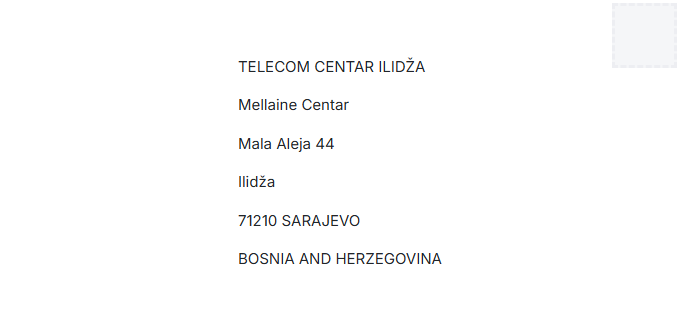
Address Example
Example of standardized Bosnia and Herzegovina postal addresses
Country Info
Full Country Name: Bosnia and Herzegovina
| Country Alpha-2 code | BA |
|---|---|
| Country Alpha-3 code | BIH |
| Numeric Code | 070 |
Time Zone
Bosnia and Herzegovina Time Zone Details
| Time Zone | UTC | DST |
|---|---|---|
| Central European Time | UTC+1 | UTC+2 |
Official Language
Bosnian, Croatian, and Serbian are the official languages. Both Latin and Cyrillic scripts are official; Latin script is dominant in the Federation of Bosnia and Herzegovina, while Cyrillic and Latin are both used in Republika Srpska.
Fun Fact
- The total area of Bosnia and Herzegovina is about 51,197 sq km / 19,767 sq miles. (CIA World Factbook)
- Bosnia and Herzegovina is nearly landlocked, bordered by Croatia, Serbia, and Montenegro, with a 20 km coastline at Neum. (CIA World Factbook)
- The terrain consists of rugged mountains, valleys, and hills, with a small lowland strip along the northern Sava River basin. (CIA World Factbook)
Postal Authority
Bosnia and Herzegovina has three national postal operators that serve different administrative entities under the post-Dayton structure. Joint inter-entity service has been coordinated across all three operators since October 2016.
-
JP BH Pošta d.o.o. Sarajevo (BH Pošta) serves the Federation of Bosnia and Herzegovina, with comprehensive mail, parcel, and financial services across the entity’s cantons and municipalities.
Reference: https://www.posta.ba
-
Pošte Srpske a.d. Banja Luka is the public postal operator of Republika Srpska, providing mail, parcel, and financial services across the entity from its headquarters in Banja Luka.
Reference: https://www.postesrpske.com
-
Hrvatska pošta d.o.o. Mostar (HP Mostar) provides postal services in Croat-majority areas of the Federation of Bosnia and Herzegovina, headquartered in Mostar.
Reference: https://www.post.ba
Postal Code Format
In Bosnia and Herzegovina, postal codes consist of 5 digits formatted as NNNNN. The first digit indicates the region or entity. The postal code appears before the city/locality name on the same line. Addresses are written with the street name followed by the house number, then the postal code and city.
Example: Zmaja od Bosne 10, 71000 Sarajevo
Name Conventions
Population Names
In Bosnia and Herzegovina, names follow the Western naming convention with the given name preceding the family name. Naming traditions reflect the country’s three constituent peoples — Bosniaks, Croats, and Serbs — as well as smaller national minorities:
[opt: title] [given name] [opt: rare. middle name / patronymic] [FAMILY NAME]
Examples:
- Gospodin Amar Begović
- Gospođa Ivana Marić
- Dr. Milan Jovanović
- Prof. dr. Selma Hodžić
Surnames most commonly end in -ić or -vić, a patronymic suffix shared across all three constituent peoples. Bosniak (Muslim) surnames are often of Ottoman-Turkish or Arabic origin and frequently end in -ović, -ević, -begović, or -hodžić. Croat surnames also commonly end in -ić. Serb surnames may end in -ić, -ov, or -ev.
In Republika Srpska, names are routinely written in both Cyrillic and Latin scripts; in the Federation of Bosnia and Herzegovina, Latin script predominates. Diacritical marks (č, ć, đ, š, ž) are part of standard spellings and should be preserved.
Common titles include Gospodin (Mr.), Gospođa (Mrs.), and Gospođica (Miss). Professional and academic titles such as Dr., Prof., Mr. sci. (master of science), and Dipl. ing. (diploma engineer) are frequently used.
A patronymic — the father’s given name — can be included as a middle name on official documents but is less commonly used socially.
Upon marriage, individuals may keep their surname, adopt their partner’s surname, or use both names (typically hyphenated). Practices vary by family and region.
Personal names are governed by entity-level civil registry laws in the Federation of Bosnia and Herzegovina, Republika Srpska, and Brčko District.
Organizational Names
Bosnia and Herzegovina businesses must register with the competent entity-level court registry. Common legal entity designations include:
- d.o.o. (Društvo s ograničenom odgovornošću) – Limited Liability Company
- d.d. (Dioničko društvo) – Joint-Stock Company, Federation of Bosnia and Herzegovina
- a.d. (Akcionarsko društvo) – Joint-Stock Company, Republika Srpska
- k.d. (Komanditno društvo) – Limited Partnership
- j.t.d. / o.d. (Javno trgovačko društvo / Ortačko društvo) – General Partnership
Company names must be unique within the relevant court registry, must not be misleading, and must not suggest unauthorized affiliation with the state. The legal entity designation typically appears at the end of the company name.