






This guide provides a comprehensive overview of Bolivia address formatting, postal code structures, and localization practices. It includes information on postal services, languages, time zones, and address validation standards across Bolivia.
Address Format
Structure for standardized Bolivia postal addresses:
- Addressee or Organization
- Thoroughfare PremisesNumber Building SubBuilding SubPremisesLevel SubPremises
- Locality
- Country
Address Verification Data
Bolivia postal addresses verification data
| Available | Yes |
| Does the country use postal codes? | No |
| PO Box Indicator | Apartado Postal, Casilla Postal, Casilla de Correos, PO Box |
| ISO-2-Code | BO |
| ISO-3-Code | BOL |
| Phonecode | 591 |
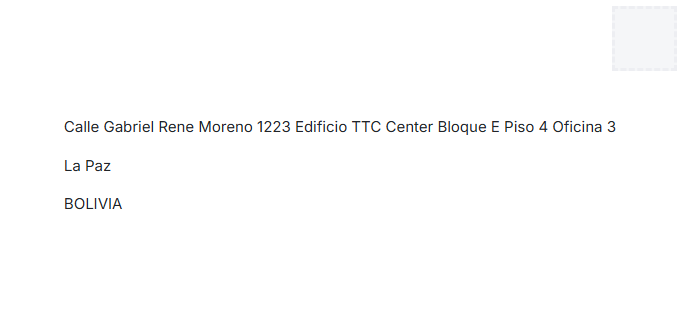
Address Example
Example of standardized Bolivia postal addresses
Country Info
Full Country Name: Plurinational State of Bolivia
| Country Alpha-2 code | BO |
|---|---|
| Country Alpha-3 code | BOL |
| Numeric Code | 068 |
Time Zone
Bolivia Time Zone Details
| Time Zone | UTC | DST |
|---|---|---|
| Bolivia Time | UTC-4 | N/A |
Daylight saving time is not observed.
Official Language
Under the 2009 Constitution, Spanish and 36 indigenous languages are recognized as official, for a total of 37. The most widely spoken indigenous languages are Quechua, Aymara, and Guaraní; others include Bésiro (Chiquitano), Mojeño-trinitario, Mojeño-ignaciano, and Movima.
Fun Facts
- The total area of Bolivia is about 1,098,581 sq km / 424,164 sq miles. (CIA World Factbook)
- Bolivia is landlocked, bordered by Brazil, Peru, Chile, Argentina, and Paraguay. (CIA World Factbook)
- Bolivia has one of the highest indigenous-identifying shares in South America. (CIA World Factbook)
- The terrain features the Andes mountains and the Altiplano high plateau in the west, the Yungas valleys, and Amazon lowlands in the east, and the country shares Lake Titicaca, the world’s highest navigable lake, with Peru. (CIA World Factbook)
Postal Authority
Agencia Boliviana de Correos (AgBC), branded as Correos de Bolivia, is the national public postal operator of Bolivia. It was created by Supreme Decree N° 3495 in March 2018 to succeed the previous public operator, Empresa de Correos de Bolivia (ECOBOL), and provides domestic and international mail and parcel services across all departments.
Reference: https://correos.gob.bo
Postal Code Format
Bolivia does not use an official postal code system. The Universal Postal Union and Agencia Boliviana de Correos do not publish a national postcode standard, and mail is routed by locality and department name. Some online forms use unofficial 4-digit conventions (such as “0000” or city-specific codes like “0201” for La Paz), but these are not issued by Bolivia’s postal authority.
Example: Calle Gabriel René Moreno 1223, La Paz, Bolivia
Name Conventions
Population Names
In Bolivia, names follow the standard Spanish naming convention with the given name(s) preceding the paternal and maternal surnames:
[opt: title] [given name(s)] [PATERNAL SURNAME] [MATERNAL SURNAME]
Examples:
- Juan Carlos Mamani Quispe
- Sra. María Elena Flores Choque
- Dr. Luis Fernando Pérez Rojas
- Lic. Ana Lucía Condori Yupanqui
The paternal surname (apellido paterno) inherits from the father and is used in everyday address; the maternal surname (apellido materno) inherits from the mother and is included in legal and formal contexts.
Common titles include Sr. (Señor), Sra. (Señora), Srta. (Señorita), and the respectful forms Don and Doña used with first names. Professional titles such as Dr. (Doctor), Lic. (Licenciado), Ing. (Ingeniero), Prof. (Profesor), Arq. (Arquitecto), and Abg. (Abogado) are commonly used.
Indigenous surnames are extremely common, particularly in the Altiplano and western departments. Aymara and Quechua family names such as Mamani, Quispe, Choque, Condori, Apaza, Ticona, Yupanqui, Huanca, Callisaya, and Chambi are widely used. Indigenous given names (for example, Wara, Inti, or Amaru) also appear alongside Spanish names.
Following Spanish-speaking tradition, women legally retain their birth surnames upon marriage. Socially, a woman may append “de [husband’s paternal surname]" (for example, María Flores Rojas de Mamani), though this practice has declined among younger generations.
Diacritical marks (á, é, í, ó, ú, ñ) are part of standard spellings and should be preserved.
Organizational Names
Bolivian businesses must register with the Servicio Plurinacional de Registro de Comercio (SEPREC), which replaced the previous concessionaire FUNDEMPRESA in 2021. Common legal entity designations include:
- S.R.L. (Sociedad de Responsabilidad Limitada) – Limited Liability Company
- S.A. (Sociedad Anónima) – Joint-Stock Company
- Sociedad Colectiva – General Partnership
- Sociedad en Comandita Simple – Limited Partnership
- E.U. (Empresa Unipersonal) – Sole Proprietorship
- Cooperativa – Cooperative Enterprise
Company names must be unique within the Commercial Registry, must not be misleading, and must not suggest unauthorized affiliation with the state. The legal entity designation typically appears at the end of the company name.