






This guide provides a comprehensive overview of Belgium address formatting, postal code structures, and localization practices. It includes information on postal services, languages, time zones, and address validation standards across Belgium.
Address Format
Structure for standardized Belgium postal addresses:
- Organization
- Building SubBuilding SubPremisesLevel SubPremises
- Thoroughfare PremisesNumber BoxNumber
- PostalCode Locality
- Country
Address Verification Data
Belgium postal addresses verification data
| Available | Yes |
| Does the country use postal codes? | Yes |
| PO Box Indicator | Postbus, Boîte Postale, Postfach |
| ISO-2-Code | BE |
| ISO-3-Code | BEL |
| Phonecode | 32 |
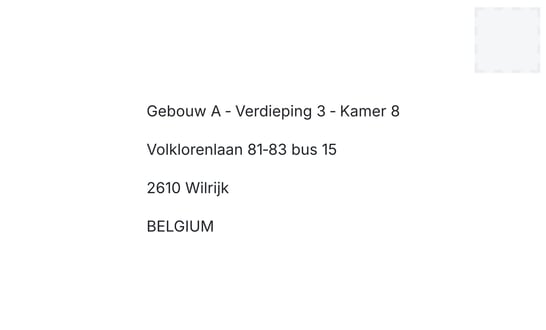
Address Example
Example of standardized Belgium postal address
Country Info
Full Country Name: Kingdom of Belgium
| Country Alpha-2 code | BE |
|---|---|
| Country Alpha-3 code | BEL |
| Numeric Code | 056 |
Time Zone
Belgium Time Zone Details
| Time Zone | UTC | DST |
|---|---|---|
| Central European Time | UTC+1 | UTC+2 |
Official Language
Dutch, French, and German are the three official languages. Dutch is spoken in Flanders, French in Wallonia, and German in a small eastern region.
Fun Facts
- The total area of Belgium is about 30,528 sq km / 11,787 sq miles. (CIA World Factbook)
- Belgium has a short coastline of about 67 km / 42 miles along the North Sea. (CIA World Factbook)
- Belgium has one of the highest population densities in Europe. (CIA World Factbook)
- The terrain is mostly flat to gently rolling plains, with more rugged hills in the Ardennes region in the southeast. (CIA World Factbook)
Postal Authority
Bpost is the national postal service of Belgium. It provides comprehensive mail and parcel delivery services, financial services, and logistics throughout all regions of Belgium.
Reference: https://www.bpost.be
Name Conventions
Population Names
In Belgium, names follow the Western naming convention, with variations between the Flemish (Dutch), French, and German communities:
[opt: title] [given name] [opt: middle name(s)] [FAMILY NAME] [opt: suffix: rare]
Examples:
- M. Jean Dupont (French)
- Dhr. Jean-Pieter Janssens (Dutch)
- Mevr. Sofie van den Berg (Dutch)
- Mme Marie Dubois (French)
Belgian names reflect the linguistic diversity of the country, with Dutch/Flemish names in Flanders, French names in Wallonia, and German names in the eastern cantons.
Common titles include Monsieur/M. (Mr.), Madame/Mme (Mrs./Ms.) in French; Meneer/Dhr. (Mr.), Mevrouw/Mevr. (Mrs./Ms.) in Dutch; Herr (Mr.), Frau (Mrs./Ms.) in German.
Dutch/Flemish surnames often include prefixes like "van," "de," "van de," "van den," or "van der," which are part of the surname but written in lowercase.
French Belgian names follow French conventions and may include particles like "de," "du," or "des."
Upon marriage, Belgian law allows spouses to keep their names, adopt their partner's name, or use both names in daily life. Legally, individuals retain their birth name.
The Belgian civil registry (Service de l'État Civil / Burgerlijke Stand) manages name registration.
Multiple given names are common, especially in French-speaking communities where religious names remain popular.
Organizational Names
Belgian businesses must register with the Crossroads Bank for Enterprises (CBE/KBO). Common legal entity designations include:
- SA/NV (Société Anonyme / Naamloze Vennootschap) – Public limited company
- SPRL/BVBA (Société Privée à Responsabilité Limitée / Besloten Vennootschap met Beperkte Aansprakelijkheid) – Private limited company
- SRL/BV (Société à Responsabilité Limitée / Besloten Vennootschap) – Limited liability company (new form since 2019)
- SC/CV (Société Coopérative / Coöperatieve Vennootschap) – Cooperative company
- SNC/VOF (Société en Nom Collectif / Vennootschap onder Firma) – General partnership
Company names must be unique and can be in any of the three official languages. The legal designation appears at the end in both French and Dutch forms (e.g., SA/NV).