







This guide provides a comprehensive overview of Denmark address formatting, postal code structures, and localization practices. It includes information on postal services, languages, time zones, and address validation standards across Denmark.
Address Format
Structure for standardized Denmark postal addresses.
- Organization
- Thoroughfare PremisesNumber SubPremises
- PostBoxType PostBoxNumber
- PostalCode Locality
- Country
Address Verification Data
Denmark postal addresses verification data.
| Available: | Yes |
| Does the country use Postal Codes: | Yes |
| PO Box Indicator: | Postboks |
| ISO-2-Code: | DK |
| ISO-3-Code: | DNK |
| Phonecode: | 45 |
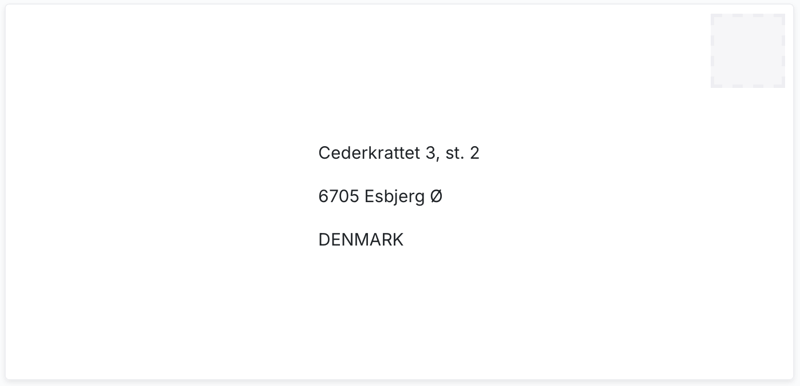
Address Example
Example of standardized Denmark postal addresses.
Country Info
Full Country Name: Kingdom of Denmark
| Country Alpha-2 code | DK |
|---|---|
| Country Alpha-3 code | DNK |
| Numeric Code | 208 |
Timezone
Belgium Time Zone Details
| Time Zone | UTC | DST |
|---|---|---|
|
Central European Time |
UTC+1 | UTC+2 |
Official Language
Danish is the official language. German is recognized as a minority language in Southern Jutland. Greenlandic and Faroese are official languages in Greenland and the Faroe Islands respectively.
Fun Fact
- The total area of Denmark is about 43,094 sq km / 16,639 sq miles, including the Jutland Peninsula and numerous islands but excluding Greenland and the Faroe Islands. (CIA World Factbook)
- Denmark has a coastline of approximately 7,314 km / 4,545 miles, reflecting its highly indented shoreline and island geography. (CIA World Factbook)
- Denmark became a constitutional monarchy in 1849, transitioning from absolute monarchy. (CIA World Factbook)
- Natural hazards are limited, mainly flooding and storms, particularly along low-lying coastal areas. (CIA World Factbook)
- Life expectancy averages around 81 years, supported by a comprehensive public healthcare system. (CIA World Factbook)
- The population is aging with a low birth rate, similar to other Northern European countries. (CIA World Factbook)
- The terrain is mostly flat to gently rolling, making Denmark one of the flattest countries in Europe. (CIA World Factbook)
Name Conventions
Population Names
In Denmark, names follow the Western naming convention with given name(s) preceding the family name:
[opt: title] [given name] [opt: middle name(s)] [FAMILY NAME]
Examples:
- Lars Nielsen
- Arnfast, Fru June Søderberg
- Dr. Peter Hansen
- Mette Andersen
Danish names use the Latin alphabet with the additional letters æ, ø, and å.
Common titles include Hr. (Mr.), Fru (Mrs.), and Frk. (Miss, rarely used). Professional titles like Dr. and Prof. are also used.
Danish surnames historically were patronymic (ending in -sen or -son), but became hereditary family names in the late 19th century.
Upon marriage, either spouse may keep their surname, adopt their partner's surname, or both may use a hyphenated combination. Since 2006, couples can also create a new combined surname.
Danish naming law regulates given names, requiring approval for uncommon names. The name must clearly indicate gender and cannot cause ridicule or be unsuitable.
Middle names are common and may include multiple names passed down through family generations.
Organizational Names:
Danish businesses must register with the Danish Business Authority (Erhvervsstyrelsen). Common legal entity designations include:
A/S (Aktieselskab) – Public limited company
ApS (Anpartsselskab) – Private limited company
I/S (Interessentskab) – General partnership
K/S (Kommanditselskab) – Limited partnership
IVS (Iværksætterselskab) – Entrepreneurial company
Company names must be distinguishable from existing companies and cannot be misleading or offensive. The legal designation typically appears at the end of the company name.