







This guide provides a comprehensive overview of Hungary address formatting, postal code structures, and localization practices. It includes information on postal services, languages, time zones, and address validation standards across Hungary.
Address Format
Structure for standardized Hungary postal addresses.
- Organization
- Locality
- DependentLocality
- Thoroughfare PremisesNumber. Building SubBuilding SubPremisesLevel SubPremises
- PostBoxType PostBoxNumber
- PostalCode
- Country
Address Verification Data
Hungary postal addresses verification data.
| Available: | Yes |
| Does the country use Postal Codes: | Yes |
| PO Box Indicator: |
Pf. |
| ISO-2-Code: | HU |
| ISO-3-Code: | HUN |
| Phonecode: | 36 |
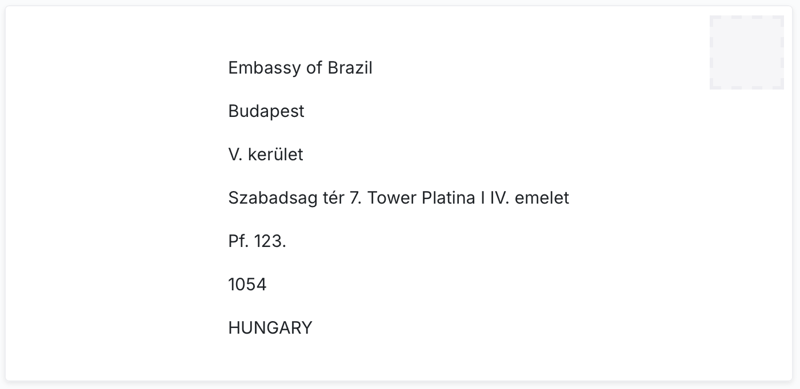
Address Example
Example of standardized Hungary postal addresses.
Country Info
Full Country Name: Hungary
| Country Alpha-2 code | HU |
|---|---|
| Country Alpha-3 code | HUN |
| Numeric Code | 348 |
Timezone
Hungary Time Zone Details
| Time Zone | UTC | DST |
|---|---|---|
|
Central European Time |
UTC+1 | UTC+2 |
Official Language
Hungarian (Magyar) is the official language.
Fun Fact
- The total area of Hungary is about 93,028 sq km / 35,918 sq miles. (CIA World Factbook)
- Hungary is landlocked, bordered by Austria, Slovakia, Ukraine, Romania, Serbia, Croatia, and Slovenia. (CIA World Factbook)
- Modern Hungary became an independent republic in 1918 following the collapse of the Austro-Hungarian Empire. (CIA World Factbook)
- Natural hazards include flooding, particularly along the Danube and Tisza rivers. (CIA World Factbook)
- Life expectancy averages around 76–77 years, below the EU average but gradually improving. (CIA World Factbook)
- The population is declining and aging, with low birth rates and outward migration. (CIA World Factbook)
- The terrain is mostly flat plains, dominated by the Great Hungarian Plain with some hills in the north and west. (CIA World Factbook)
Name Conventions
Population Names
In Hungary, names follow the Eastern naming convention with family name preceding given name(s), similar to other Asian naming systems:
[opt: prof. title] [FAMILY NAME] [given name] [opt: second given name] [opt: social title]
Examples:
- Nagy János úr
- Kovács Anna
- Dr. Szabó Péter
- Horváth Mária asszony
Hungarian names use the Latin alphabet with additional diacritical marks (á, é, í, ó, ö, ő, ú, ü, ű).
The distinctive feature of Hungarian naming is that the family name comes first, followed by the given name(s), even when written in Latin script.
Common social titles include Úr (Mr.), Asszony (Mrs.), Hölgy/Kisasszony and (Ms./Miss), which commonly come after the forename, and professional titles like Dr., Prof. which precede the surname. Social and Professional titles are usually not combined.
Hungarian surnames often indicate occupations (e.g., Kovács = blacksmith), characteristics, or places of origin.
Upon marriage, women traditionally adopt their husband's full name in the form "husband's surname + husband's given name + -né" (e.g., Nagy János's wife becomes Nagy Jánosné), though modern practice allows women to keep their maiden names or use various combinations.
When Hungarians interact internationally, they may reverse their name order to given name + family name to match Western conventions.
Hungarian naming law allows considerable freedom, but names must not be ridiculous or cause difficulties for the child.
Organizational Names:
Hungarian businesses must register with the Company Registry. Common legal entity designations include:
Zrt. (Zártkörűen működő részvénytársaság) – Private company limited by shares
Nyrt. (Nyilvánosan működő részvénytársaság) – Public company limited by shares
Kft. (Korlátolt felelősségű társaság) – Limited liability company
Bt. (Betéti társaság) – Limited partnership
Kkt. (Közkereseti társaság) – General partnership
Company names must be unique and not misleading. The legal designation typically appears at the end of the company name.