






This guide provides a comprehensive overview of Chile address formatting, postal code structures, and localization practices. It includes information on postal services, languages, time zones, and address validation standards across Chile.
Address Format
Structure for standardized Chile postal addresses.
- Organization or Addressee
- Building SubBuilding
- PostBoxType PostBoxNumber
- Thoroughfare PremisesNumber SubPremises SubPremisesLevel
- Locality, SubAdministrativeArea OR Locality
- PostalCode
- Country
Address Verification Data
Chile postal addresses verification data.
| Available: | Yes |
| Does the country use Postal Codes: | Yes |
| PO Box Indicator: | Casilla |
| ISO-2-Code: | CL |
| ISO-3-Code: | CHL |
| Phonecode: | 56 |
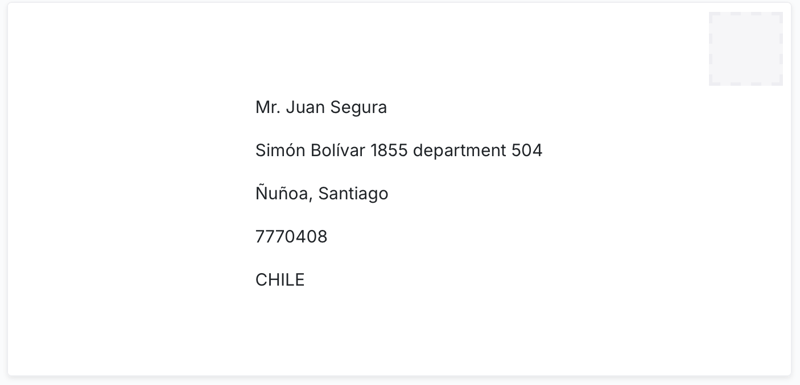
Address Example
Example of standardized Chile postal addresses.
Country Info
Full Country Name: Republic of Chile
| Country Alpha-2 code | CL |
|---|---|
| Country Alpha-3 code | CHL |
| Numeric Code | 152 |
Timezone
Chile Time Zone Details
| Time Zone | UTC | DST |
|---|---|---|
|
Chile Standard Time |
UTC-4 | UTC-3 |
|
Easter Island Standard Time |
UTC-6 | UTC-5 |
Official Language
Spanish is the official language. Indigenous languages such as Mapudungun, Aymara, and Rapa Nui are spoken by indigenous communities.
Fun Fact
- The total area of Chile is about 756,102 sq km / 291,933 sq miles, stretching over 4,300 km (2,670 miles) from north to south. (CIA World Factbook)
- Chile has a coastline of approximately 6,435 km / 3,999 miles along the Pacific Ocean. (CIA World Factbook)
- Chile gained independence from Spain in 1818, establishing itself as a sovereign republic. (CIA World Factbook)
- Natural hazards include frequent earthquakes, tsunamis, and volcanic eruptions, as Chile lies along the Pacific Ring of Fire. (CIA World Factbook)
- Life expectancy averages around 81 years, among the highest in Latin America. (CIA World Factbook)
- The population is aging gradually, with declining birth rates and increasing urbanization. (CIA World Factbook)
- The terrain is highly diverse, featuring the Atacama Desert in the north, the Andes Mountains along the east, fertile central valleys, and glaciers and fjords in the south. (CIA World Factbook)
Name Conventions
Population Names:
In Chile, names follow the Spanish naming convention with one or more given names followed by paternal and maternal surnames:
[opt: title] [given name] [opt: second given name] [paternal surname] [maternal surname]
Examples:
- DR. MIGUEL LUIS ESTRADA MENDOZA
- Ing. Luciana Salazar Rojas
- Dr. Luis Alberto Fernández Pérez
- Francisca Paz Muñoz Rojas
Chilean names use the Spanish alphabet including accented characters (á, é, í, ó, ú, ñ).
Common titles include Sr. (Señor), Sra. (Señora), Srta. (Señorita), and professional titles like Dr., Ing. (Ingeniero), Abog. (Abogado).
Both paternal and maternal surnames are used in formal documentation, with the paternal surname appearing first.
Women retain their maiden names after marriage and do not traditionally adopt their husband's surname.
Compound given names are popular, often including María or José (e.g., María Paz, José Miguel).
The Registro Civil (Civil Registry) governs name registration and has rules about acceptable names.
Organizational Names:
Chilean businesses must register with the Registro de Empresas y Sociedades. Common legal entity designations include:
- S.A. (Sociedad Anónima) – Stock corporation
- SpA (Sociedad por Acciones) – Corporation by shares
- Ltda. (Sociedad de Responsabilidad Limitada) – Limited liability company
- S.C.S. (Sociedad en Comandita Simple) – Simple limited partnership
- EIRL (Empresa Individual de Responsabilidad Limitada) – Individual limited liability company
Company names must be unique and distinguishable from existing entities. The legal designation typically appears at the end of the company name.